Adventure Tourism Market Size to Reach $1,989.2B by 2034: Trends & Forecast
 Bobby Yadav
02 Mar, 2026
13 mins read
72
Bobby Yadav
02 Mar, 2026
13 mins read
72
Market Overview
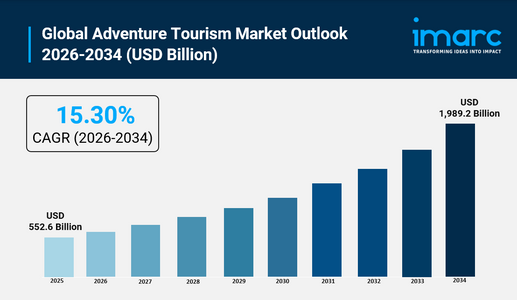
The global adventure tourism market reached a size of USD 552.6 Billion in 2025. Forecasts from IMARC Group show the market is projected to reach USD 1,989.2 Billion by 2034, expanding at a CAGR of 15.30% between 2026 and 2034. The sector is propelled by a surge in authentic, personalized travel experiences, technological advancements, and social media influence.
Study Assumption Years
- Base Year: 2025
- Historical Year/Period: 2020-2025
- Forecast Year/Period: 2026-2034
Adventure Tourism Market Key Takeaways
- Current Market Size: USD 552.6 Billion (2025)
- CAGR: 15.30% (2026-2034)
- Forecast Period: 2026-2034
- The market is expected to reach USD 1,989.2 Billion by 2034.
- Soft adventure is the largest segment, credited to accessibility and lower barriers to participation.
- Land-based activities, such as hiking and trekking, dominate due to their broad appeal and easier accessibility.
- The 30–41 years age group forms the largest consumer segment, driven by higher disposable income and desire for transformative experiences.
- Direct sales channels are most dominant, providing customized offerings and greater profit margins.
Request for sample copy of this report: https://www.imarcgroup.com/adventure-tourism-market/requestsample
Market Growth Factors
Surge in Disposable Income and Experiential Spending
A fundamental driver for the market is the rising disposable income across both developed and emerging economies, which is being funneled into high-value experiential travel. In 2026, data indicates that the 30–50 age demographic—which controls roughly 45% of global travel spending—is increasingly opting for adventure-based vacations over static resort stays. In the United States alone, disposable personal income saw a steady increase in early 2025, providing households with the financial flexibility to book premium guided expeditions and multi-day treks. This economic surplus is particularly impactful in the Asia-Pacific region, where a burgeoning middle class in China and India is seeking "status through experience." Consequently, operators are seeing a spike in bookings for all-inclusive adventure packages that range from $3,000 to $10,000 per person, as consumers prioritize memories and personal milestones as their primary form of discretionary investment.
Strategic Government Investment in Infrastructure and Conservation
Governments worldwide are aggressively promoting adventure tourism as a tool for rural economic development and environmental stewardship. In 2026, initiatives like India’s "Swadesh Darshan 2.0" have funneled over ₹3,200 crore into developing specialized adventure circuits, including trekking routes in the Himalayas and water-based infrastructure in the Andaman Islands. Similarly, the United Nations Tourism body has launched a roadmap for sustainable and resilient tourism, encouraging nations to diversify their revenue streams by opening up previously inaccessible remote regions. These public-sector efforts include the modernization of regional airports and the implementation of standardized safety certifications for local guides. By improving accessibility to "off-the-beaten-path" destinations, such as the mountain trails of Kyrgyzstan or the wildlife corridors of Zimbabwe, governments are effectively lowering the barriers to entry for international tourists while ensuring that tourism revenue directly benefits local indigenous communities.
The Influence of Social Media and Digital Storytelling
The visual nature of modern social media platforms continues to act as a powerful catalyst for the adventure tourism industry. Platforms like Instagram and TikTok are saturated with high-definition, user-generated content showcasing breathtaking landscapes and "bucket-list" achievements, such as paragliding in Switzerland or diving in the Great Barrier Reef. This digital "word-of-mouth" creates a powerful FOMO (fear of missing out) effect among younger demographics, with millennials and Gen Z accounting for nearly 4.2 billion of the global population. Travel brands are leveraging this by partnering with influencers to produce immersive videography that highlights the safety and accessibility of extreme sports. In 2026, over 60% of adventure travelers report that their choice of destination was directly influenced by social media content. This continuous stream of captivating imagery not only inspires new travelers but also builds a global community of enthusiasts who share real-time reviews and safety tips online.
Key Trends
The Rise of "Micro-Retirements" and Sabbatical Travel
A prominent trend in 2026 is the "micro-retirement," where mid-career professionals take extended breaks of three to six weeks for ambitious adventure itineraries traditionally reserved for later life. Rather than waiting for official retirement, travelers are utilizing flexible work-from-anywhere policies to embark on long-term treks in Patagonia or slow-travel cycling routes through Vietnam. Booking data from major operators like Explore Worldwide shows a 19% increase in trips lasting longer than eight days compared to previous periods. This shift is supported by new "back-to-back" travel offers that allow adventurers to link multiple expeditions into a single, cohesive journey. These micro-retirements are often viewed as a "digital reset," providing a deliberate break from the high-pressure corporate environment. This trend is transforming the industry from a seasonal market into a year-round utility as professionals seek to balance their career ambitions with meaningful, high-intensity outdoor exploration.
"Adventure, Refined" and the Growth of Soft Adventure
The "soft adventure" segment has become the dominant force in the market, capturing over 65% of the total revenue share by offering a blend of physical thrill and boutique comfort. This trend, often called "adventure, refined," caters to travelers who want to spend their days hiking or bison-tracking in Romania but prefer to spend their nights in high-end, eco-friendly lodges with gourmet dining. Companies like Much Better Adventures and Backroads are seeing a surge in "active-leisure" bookings, where the focus is on accessible activities like e-biking or guided wildlife safaris. This model is particularly popular among families and travelers over 50, who value the safety and logistical ease of a professionally managed tour. By removing the "roughing it" element of traditional exploration, the industry is successfully attracting a much broader audience that seeks the health benefits of being in nature without sacrificing the comforts of modern hospitality.
Integration of High-Tech Safety and Real-Time Tracking
Safety technology has transitioned from an optional extra to a standard expectation for adventure travelers in 2026. Modern expeditions are now equipped with real-time satellite tracking, advanced weather forecasting AI, and wearable health monitors that sync directly with the tour operator's command center. This "tech-enabled safety" trend is crucial for the growth of "hard adventure" activities like mountaineering and white-water rafting, as it significantly reduces the perceived risks for participants. For example, GPS-enabled "smart helmets" and emergency communication beacons are now routinely provided in remote trekking packages. Furthermore, virtual reality (VR) is being used for pre-trip "previews," allowing travelers to familiarize themselves with the terrain and technical requirements of a climb before they even leave home. This focus on technological security not only enhances the user experience but also allows operators to expand their services into more challenging and remote geographical areas with higher confidence.
Market Segmentation
By Type:
- Hard Adventure
- Soft Adventure
Soft adventure represents the largest segment, attributed to activities such as hiking and snorkeling that are broadly accessible and less risky, appealing to travelers across different ages and fitness levels.
By Activity:
- Land-based Activity
Land-based adventure, including hiking and mountain biking, holds the largest share, enabled by geographic accessibility and limited need for specialized skills or equipment.
- Water-based Activity
- Air-based Activity
By Age Group:
- Below 30 Years
- 30–41 Years
Individuals aged 30–41 years comprise the leading market group, distinguished by increased disposable income, life stability, and a keen interest in challenging and transformative experiences.
- 42–49 Years
- 50 Years and Above
By Sales Channel:
- Travel Agent
- Direct
Direct channels dominate, granting providers customization capability and improved profit margins, thereby bolstering market growth and customer loyalty.
By Region:
- North America (United States, Canada)
- Asia-Pacific (China, Japan, India, South Korea, Australia, Indonesia, Others)
- Europe (Germany, France, United Kingdom, Italy, Spain, Russia, Others)
- Latin America (Brazil, Mexico, Others)
- Middle East and Africa
Regional Insights
Europe leads the adventure tourism market, accounting for the largest market share. The region benefits from diverse landscapes and well-developed infrastructure, such as national parks and extensive trail networks, making it especially attractive and accessible for a wide range of adventure activities.
Recent Developments & News
- In April 2023, Abercrombie & Kent launched a new expedition cruise enabling guests to travel to Earth's northernmost point.
- In December 2022, Active Adventures and Austin Adventures unveiled revamped brand identities focused on global adventure experiences.
- In April 2021, Trivago collaborated with TUI Group to provide users direct access to over 55,000 excursions, activities, and tickets.
Key Players
- Abercrombie & Kent USA LLC
- Austin Adventures Inc.
- Butterfield & Robinson Inc.
- Cox & Kings Ltd.
- Discovery Nomads
- G Adventures
- Geographic Expeditions Inc.
- Intrepid Group Limited
- Mountain Travel Sobek
- Recreational Equipment Inc.
- ROW Adventures
- TUI AG
If you require any specific information that is not covered currently within the scope of the report, we will provide the same as a part of the customization.
About Us
IMARC Group is a global management consulting firm that helps the world’s most ambitious changemakers to create a lasting impact. The company provide a comprehensive suite of market entry and expansion services. IMARC offerings include thorough market assessment, feasibility studies, company incorporation assistance, factory setup support, regulatory approvals and licensing navigation, branding, marketing and sales strategies, competitive landscape and benchmarking analyses, pricing and cost research, and procurement research.
Contact Us
IMARC Group,
134 N 4th St. Brooklyn, NY 11249, USA,
Email: sales@imarcgroup.com,
Tel No: (D) +91 120 433 0800,
United States: +1-201971-6302
Written By:
Bobby Yadav

Hotels at your convenience
Now choose your stay according to your preference. From finding a place for your dream destination or a mere weekend getaway to business accommodations or brief stay, we have got you covered. Explore hotels as per your mood.