Ancient Travel in China
 Luna Jack
30 Jan, 2026
8 mins read
163
Luna Jack
30 Jan, 2026
8 mins read
163
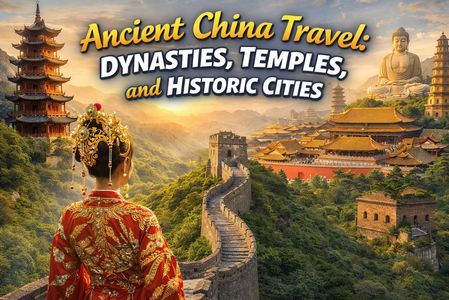
Travelling through ancient China is like stepping into a living history book. For thousands of years, powerful dynasties ruled vast lands, built monumental cities, and left behind temples that continue to inspire awe. From imperial capitals to sacred religious sites, ancient China offers travellers a deep cultural journey shaped by philosophy, art, warfare, and spiritual devotion. Exploring these historical layers provides insight into how China evolved into one of the world’s oldest continuous civilisations.
Ancient China travel is not just about sightseeing—it is about understanding traditions, stories, and symbols that still influence modern Chinese life.
The Dynasties That Shaped China
China’s history is traditionally divided into dynasties, each leaving a distinct cultural and architectural legacy. The Qin Dynasty, though short-lived, unified China and standardised writing, currency, and measurements. Its most famous legacy is the Terracotta Army in Xi’an, created to guard Emperor Qin Shi Huang in the afterlife. This archaeological marvel remains one of the most visited historical attractions in the country.
The Han Dynasty followed, ushering in a golden age of trade, governance, and cultural expansion. During this period, the Silk Road flourished, connecting China with Central Asia, the Middle East, and Europe. Many historic towns and relics along these routes still exist, offering travellers a glimpse into ancient global exchange.
The Tang Dynasty is often considered the pinnacle of Chinese civilisation. Known for its openness, artistic excellence, and economic prosperity, the Tang era transformed Chang’an (modern-day Xi’an) into the world’s largest city at the time. Today, visitors can explore ancient city walls, pagodas, and museums that preserve this vibrant legacy.
Later dynasties such as the Song, Yuan, Ming, and Qing continued to refine governance, architecture, and culture. The Ming Dynasty, in particular, is remembered for rebuilding large sections of the Great Wall and constructing the Forbidden City, which remains a symbol of imperial power and tradition.
Sacred Temples and Spiritual Heritage
Religion and philosophy played a central role in ancient Chinese society. Confucianism, Taoism, and Buddhism shaped moral values, education, governance, and daily life. Temples dedicated to these belief systems still stand across China, serving as both religious centres and cultural landmarks.
Buddhist temples such as the Shaolin Temple in Henan Province are world-famous, not only for spiritual teachings but also for martial arts traditions. The Longmen Grottoes and Mogao Caves showcase thousands of intricate Buddhist carvings and murals, reflecting centuries of devotion and artistic mastery.
Taoist temples, often built in harmony with nature, offer peaceful settings that emphasise balance and simplicity. Confucian temples, including the Temple of Confucius in Qufu, highlight the importance of scholarship, ethics, and social order in ancient China.
Visiting these temples allows travellers to experience the spiritual foundations of Chinese civilisation while appreciating architectural elegance and symbolic design.
Historic Cities That Tell Timeless Stories
China’s ancient cities are living museums, where old streets, walls, and neighbourhoods coexist with modern development. Xi’an stands out as one of the most important historical cities, having served as the capital for multiple dynasties. Its preserved city walls, ancient pagodas, and vibrant Muslim Quarter reflect centuries of cultural interaction.
Beijing, another former imperial capital, is home to the Forbidden City, the Temple of Heaven, and historic hutongs. These sites offer insight into royal life, ceremonial traditions, and urban planning during imperial rule.
Luoyang, Nanjing, and Kaifeng also played major roles in ancient governance and culture. Each city offers unique historical landmarks, from ancient academies to royal tombs, providing travellers with diverse perspectives on China’s dynastic past.
In the far west, regions connected to the Silk Road reveal a different side of ancient Chinese history. These areas highlight cultural blending, trade routes, and frontier defence systems. Travellers interested in Silk Road heritage often explore desert cities, ancient fortresses, and archaeological sites, with Xinjiang Travel offering access to historic crossroads where Chinese, Central Asian, and Middle Eastern influences merged.
Architecture, Art, and Daily Life
Ancient Chinese architecture reflects philosophical beliefs and social hierarchy. Wooden structures, curved roofs, courtyards, and symmetrical layouts emphasised harmony and order. Palaces, temples, the philosophical beliefs, and social hierarchy of its time, as well as homes, were designed according to feng shui principles, aligning human spaces with natural forces.
Art forms such as calligraphy, painting, bronze casting, and ceramics flourished across dynasties. Museums throughout China display artefacts that reveal how ancient people lived, worked, worshipped, and celebrated. These artistic traditions continue to have a profound influence on contemporary Chinese culture.
Why Ancient China Appeals to Modern Travelers
Ancient China travel attracts history lovers, cultural explorers, and curious travellers seeking meaningful experiences. Unlike destinations focused solely on leisure, China’s historical sites encourage reflection and learning. Each temple, city wall, and artefact tells a story of ambition, belief, and resilience.
Travellers gain a deeper appreciation of how ancient values—respect for ancestors, harmony with nature, and devotion to learning—still shape modern Chinese society. This connection between past and present makes ancient China travel both educational and emotionally enriching.
Final Thoughts
Exploring ancient China is a journey across dynasties, philosophies, and civilisations that shaped not only a nation but much of the world. From imperial capitals and sacred temples to Silk Road cities and artistic masterpieces, China’s historical landscape is vast and captivating. For travellers seeking depth, meaning, and timeless stories, ancient China offers an unforgettable experience that bridges thousands of years of human history.
Written By:
Luna Jack

Hotels at your convenience
Now choose your stay according to your preference. From finding a place for your dream destination or a mere weekend getaway to business accommodations or brief stay, we have got you covered. Explore hotels as per your mood.