Beyond the Dreaming Spires: Exploring Oxford’s Secret Literary History
 Griffiths Seren
29 Jan, 2026
7 mins read
67
Griffiths Seren
29 Jan, 2026
7 mins read
67
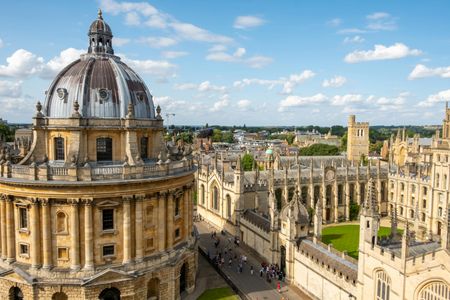
Oxford is a city that exists as much in the imagination as it does in limestone and mortar. To walk its cobbled lanes is to step through a looking glass, moving between the contemporary world and the fictional realms that were birthed within its ancient colleges. While the "Dreaming Spires"—a term coined by the poet Matthew Arnold—are the city’s most famous silhouette, the true magic of Oxford lies in the quiet corners where some of the world’s greatest narratives were penned. For the literary traveller, Oxford is not just a destination; it is a living library.
The Echoes of the Inklings
No exploration of Oxford’s literary soul is complete without visiting the haunts of the Inklings. In the 1930s and 40s, this informal group of writers, which included J.R.R. Tolkien and C.S. Lewis, met regularly to read their works-in-progress aloud. Their primary sanctuary was The Eagle and Child pub on St Giles'. Known affectionately as the "Bird and Baby," the pub’s wood-panelled "Rabbit Room" was the site where the early chapters of The Lord of the Rings and The Chronicles of Narnia first met the air.
While the pub is currently undergoing a long-awaited restoration, the atmosphere of St Giles' remains unchanged. One can easily imagine Tolkien cycling past, his mind halfway between the Radcliffe Camera and the Misty Mountains. The nearby Addison’s Walk at Magdalen College, a circular trail flanked by water meadows, was where Lewis and Tolkien shared a famous late-night conversation about the nature of myth—a talk that eventually led to Lewis’s conversion to Christianity and the subsequent creation of Aslan.
Through the Looking Glass
A short walk toward Christ Church College reveals a different kind of fantasy. It was here that Charles Dodgson, better known as Lewis Carroll, was a mathematics don. The inspiration for Alice’s Adventures in Wonderland was born during a "golden afternoon" rowing trip on the Thames with the young Alice Liddell, the Dean’s daughter.
Today, visitors can still spot the "Alice" influences embedded in the college’s architecture. The Great Hall features a fireplace with brass firedogs that have elongated necks—reminiscent of Alice’s own neck stretching after eating the cake. In the cathedral garden, an ancient chestnut tree is said to be the one where the Cheshire Cat appeared. Oxford teaches us that inspiration isn't always found in grand gestures; sometimes, it is found in the distorted reflection of a brass fixture or the shadows of a garden wall.
The Weight of Knowledge: The Bodleian
At the heart of this literary ecosystem sits the Bodleian Library. As one of the oldest libraries in Europe, it serves as the city’s intellectual anchor. To enter the Duke Humfrey’s Library is to enter a world of hushed reverence and chained books. This space has stood in for the restricted section of Hogwarts in the Harry Potter films, but its real-world history is even more compelling.
The library operates under a strict "no fire" policy; historically, scholars were forbidden from even using candles, a rule that speaks to the precious, flammable nature of the knowledge housed within. For centuries, the Bodleian has acted as a magnet for researchers and bibliophiles, creating a unique atmosphere where the pursuit of truth is the city's primary industry.
Transitioning from Visitor to Resident
For many, a brief visit to these historic sites is not enough. The city has a way of pulling people in, convincing them to trade a weekend suitcase for a more permanent bookshelf. Whether you are a postgraduate researcher diving into the archives or a creative writer seeking the "Oxford spark," the transition from tourist to local resident requires a shift in perspective.
The logistical challenge of moving to such a historic city is often the first hurdle. Oxford’s housing market is notoriously tight, preserved by its "Green Belt" and the antiquity of its structures. For those embarking on a long-term academic journey, securing well-located student accommodation in Oxford is a vital step in ensuring the city’s magic isn't overshadowed by the stresses of a long commute. Being able to walk from your front door to the very meadows that inspired poets allows for a level of immersion that a day-trip simply cannot provide. Living amongst the stone walls of Jericho or the vibrant streets of Cowley allows the modern scholar to become a part of the city's ongoing story.
The Modern Legacy
The literary tradition of Oxford did not end with the mid-century giants. Modern masters like Philip Pullman have reimagined the city in the His Dark Materials trilogy. Pullman’s Oxford is a "layered" city, where the familiar streets of the covered market coexist with parallel universes. His work reminds us that Oxford is constantly being rewritten.
Even the detective genre has found a home here. The late Colin Dexter’s Inspector Morse series turned the city’s colleges into scenes of intricate mysteries, proving that the Dreaming Spires have a dark, noir side as well. Oxford is a city of layers—academic, fictional, and historical. To truly understand it, one must be willing to get lost in its side streets, sit in its drafty libraries, and perhaps, eventually, call it home.
Written By:
Griffiths Seren

Hotels at your convenience
Now choose your stay according to your preference. From finding a place for your dream destination or a mere weekend getaway to business accommodations or brief stay, we have got you covered. Explore hotels as per your mood.