Israel Visa for US Citizens
 Lena Braun
30 Nov, 2025
17 mins read
232
Lena Braun
30 Nov, 2025
17 mins read
232

For decades, one of the great perks of being an American traveler planning a trip to Israel was the simple, visa-free entry. You booked your flight, packed your bags, and received a tourist stamp upon arrival at Ben Gurion Airport (TLV). However, as of January 1, 2025, Israel is officially joining the ranks of countries using a digital travel authorization system. This new requirement, known as the Electronic Travel Authorization for Israel, or ETA-IL, is mandatory for all citizens of visa-exempt countries, including the United States.

This comprehensive guide is designed to navigate US citizens through the new ETA-IL application, ensuring your travel plans to the Holy Land remain smooth, simple, and stress-free. We’ll cover everything about the Israel Visa for US Citizens , the basic requirements and costs to specific travel purposes and processing times.
Why ETA-IL Required for Americans?
The ETA-IL is a digital pre-screening system that grants eligible foreign nationals authorization to travel to Israel without requiring a traditional visa. It mirrors similar systems used globally, such as the ESTA in the United States and the eTA in Canada.
The primary goal of the ETA-IL is two-fold: to enhance national security by pre-screening travelers before they board their flights, and to streamline the arrival process at border control, minimizing delays and improving the overall visitor experience. Since US citizens travel to Israel frequently, this system aims to make security checks more efficient for both.
Do US Citizens Need a Visa for Israel?
No, not exactly. The vast majority of US citizens traveling for short-term purposes still do not require a full, traditional visa (like the B/2 Tourist Visa). Instead, the requirement has shifted from visa-free entry to mandatory pre-authorization.
Think of the ETA-IL not as a complex visa, but as a digital permission slip. If your travel purpose is tourism, short-term business, family visits, or other non-work/non-medical activities for less than 90 days, the ETA-IL is what you need. A full visa is only required for long-term stays, employment, or specialized academic programs.
How Long is the Israel ETA-IL Valid For? (Validity & Duration of Stay)
This is one of the most user-friendly aspects of the new system. The ETA-IL offers excellent flexibility for frequent visitors:
- Validity Period: The authorization is valid for a period of two years from the date of approval.
- Passport Condition: Crucially, the validity is tied to your passport. If your US passport expires sooner than two years, the ETA-IL authorization will expire on the same date as your passport. If you renew your passport, you must apply for a new ETA-IL.
- Entry Type: It permits multiple entries into Israel during its two-year validity.
- Duration of Stay: For any single trip, the ETA-IL permits a stay of up to 90 days within any 180-day period.
What Documents Do I Need to Apply for the ETA-IL?

The application is streamlined and requires minimal Israel Visa Requirements for US citizens, but accuracy is paramount.
The core requirements include:
- Valid US Passport: You will need to upload a high-quality scan of your Passport Bio Page.
- Passport Validity: Your passport must be valid for at least three months beyond your intended date of departure from Israel. However, the recommendation for international travel is generally six months, so it’s always safest to ensure six months validity.
- Email Address: A working email address is needed for the confirmation and receipt.
- Credit Card: For the NIS 25 fee payment.
- Travel Details: You may be asked for basic details about your first trip, such as your expected date of arrival.
What Activities are Permitted Under the ETA-IL Authorization?
The ETA-IL covers virtually all short-term, non-remunerative activities that US citizens typically undertake in Israel: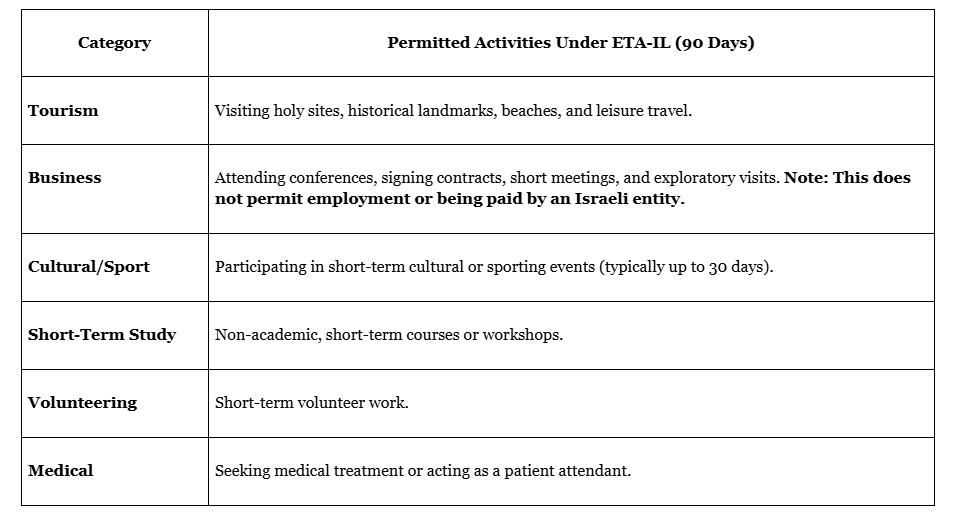 If your purpose involves working for an Israeli company or undertaking a long-term academic program (such as Taglit/Masa Israel which is mentioned as a specific category), you must apply for the corresponding B/1 (Work) or A/2 (Student) visa through the Israeli embassy or consulate before traveling.
Why wait days for a government email when the Agent provides 24/7 Real-Time Assistance?
- Official Portal: Support is typically provided by the Population and Immigration Authority (PIBA). Assistance is generally limited to working hours (Sunday to Thursday) and often relies on contact forms or specific office phone lines, meaning no instant support for travelers in different time zones or for airport emergencies.
- israel-evisa.com: Our team provides 24/7 client support. We offer assistance via Live Chat, email, and other communication platforms to ensure you have immediate access to help regardless of your time zone or the urgency of your query.
Document Stress: Why spend hours resizing files when the Agent handles all Technical Formatting for you?
- Official Portal: You are responsible for ensuring your document uploads (passport scans, photos, supporting documents for B-2) meet all technical specifications (file type, resolution, size limit). If the file is rejected or insufficient, it can significantly delay the process or lead to application rejection.
- israel-evisa.com: Our service includes document preparation and optimization. You can upload photos taken simply with your phone; our team will professionally crop, resize, and format the images to meet the exact requirements of the Israeli government system, guaranteeing smooth submission.
What is the Difference Between ETA-IL and a B/2 Tourist Visa?
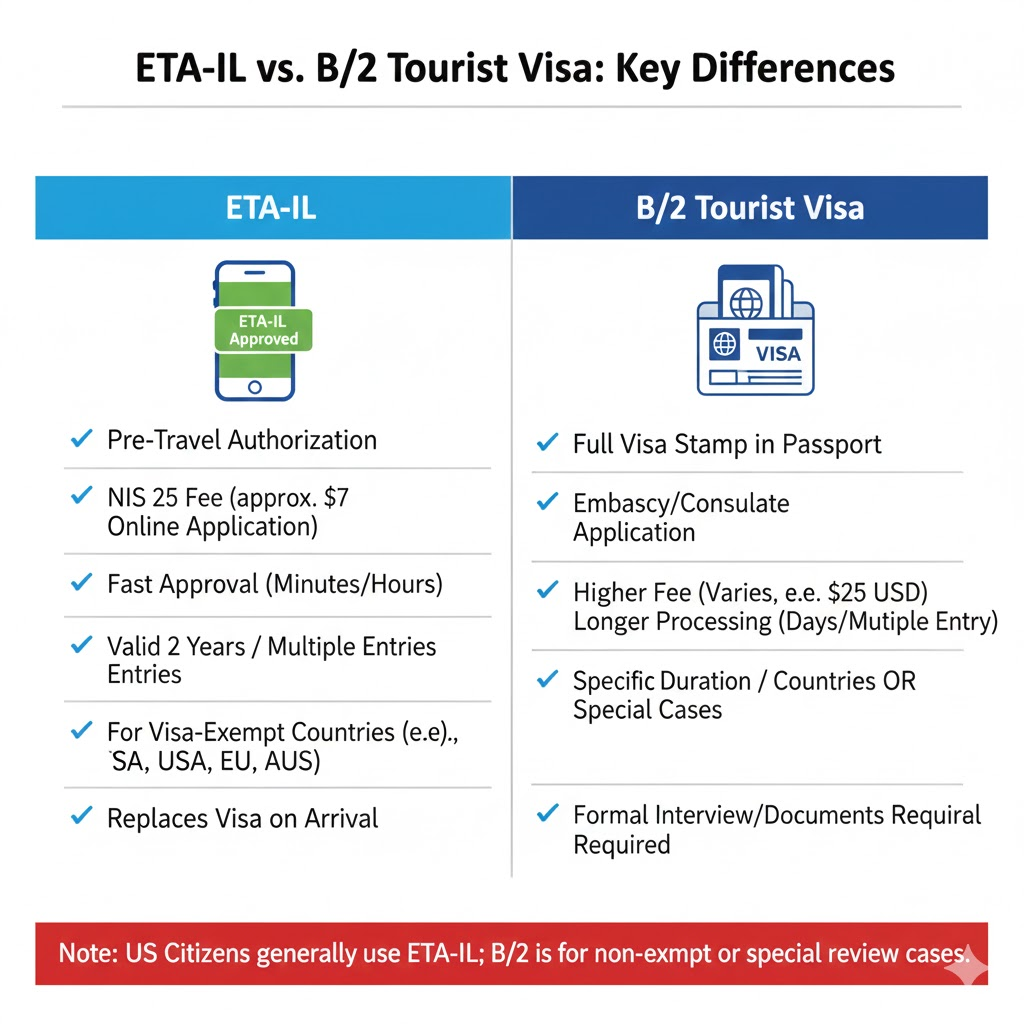
Before the ETA-IL, the B/2 visa was what was issued upon arrival to visa-exempt travelers. Now, the ETA-IL acts as the pre-approval required to board your flight.
- ETA-IL: Pre-authorization system. Cheap (NIS 25), fast, valid for two years/multiple entries, and approved online.
- B/2 Tourist Visa (Traditional): A full visa stamp issued to citizens of countries that are not visa-exempt, or to visa-exempt citizens for specific reasons, such as a recent work history in Israel. This requires a formal application process and a higher fee.
For US citizens, the ETA-IL has largely replaced the need to apply for a B/2 visa unless you have a history that requires special review.
Do Children and Minors Need an ETA-IL?
Yes. The ETA-IL requirement applies to all eligible visitors, regardless of age. If your child holds a US passport, they must have an approved ETA-IL before flying to Israel. Parents or legal guardians will apply on their behalf.
How Does ETA-IL Affect Dual Citizens (US/Israel)?
If you are a dual citizen holding both a US and an Israeli passport (or an Israeli identity number), you do not need to apply for an ETA-IL. Israeli law requires citizens, even dual nationals, to use their Israeli passport to enter and exit the country. This exemption is clearly stated in the official guidance.
Is Pre-Approval from ETA-IL a Guarantee of Entry?
It is important to understand that an approved ETA-IL is an authorization to travel, not a guarantee of entry. It simply means you are pre-cleared to board the plane and present yourself to the border control officer in Israel.
Upon arrival, the border control officer at the port of entry has the final authority to grant or deny admission into Israel. While entry refusal is rare for US citizens with an approved ETA-IL for standard tourism, you should still be prepared to answer routine questions about your:
- Purpose of visit.
- Accommodation details.
- Proof of onward or return travel.
- Sufficient funds for your stay.
What Happens if My ETA-IL Application is Denied?

While most applications from US citizens are approved swiftly, if your application is denied (e.g., due to security concerns, past immigration violations, or application errors), you are not entirely out of options.
If denied, you will receive notification and instructions. You will typically be directed to apply for a traditional B/2 Tourist Visa (or another appropriate visa) through the nearest Israeli Embassy or Consulate. This process involves an in-person interview and a more thorough review of your case.
What are the Passport Validity Rules for Israel Entry?
To avoid issues, ensure your passport is valid for at least six months beyond your departure date from Israel. While the official ETA-IL requirement mentions only three months, having a six-month buffer is a best practice universally accepted by airlines and border agencies. Renewing your passport if it is close to expiration will also maximize the two-year validity period of your ETA-IL.
How Do I Handle Travel to the West Bank or Gaza?
Travelers to the West Bank or Gaza should be aware that these areas are subject to different jurisdictions and security concerns.
- West Bank: Travel to areas under Palestinian Authority control is generally possible, but requires diligence. Use organized tours or ensure your travel insurance is comprehensive. The security situation can change rapidly.
- Gaza: Travel to Gaza is highly restricted and, due to security warnings, is explicitly advised against by the US Department of State. The ETA-IL system only authorizes travel to the State of Israel.
Always check the latest US Department of State Travel Advisory before traveling to any region in Israel or the Palestinian territories to remain informed about current security conditions.
Written By:
Lena Braun

Hotels at your convenience
Now choose your stay according to your preference. From finding a place for your dream destination or a mere weekend getaway to business accommodations or brief stay, we have got you covered. Explore hotels as per your mood.