London Historical Sites: The Ultimate Guide to London’s Historic Landmarks
 Mark Twain
01 Mar, 2026
15 mins read
149
Mark Twain
01 Mar, 2026
15 mins read
149
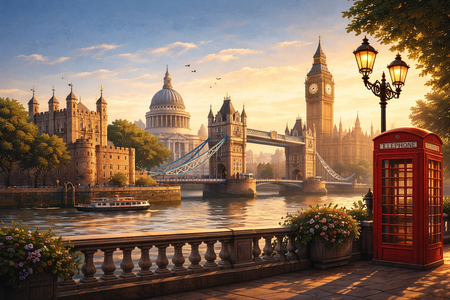
London does not tell its story in a straight line. It layers history the way old cities often do, one era resting quietly on another. A Roman wall stands a short walk from a royal palace. Medieval churches sit beside glass towers. Streets you cross without thinking once carried kings, prisoners, merchants, and revolutionaries.
That is what makes exploring London historical sites different from visiting landmarks in other cities. You are not looking at isolated monuments. You are walking through a timeline that never paused.
Some places reveal royal drama. Others speak through architecture, war scars, or centuries of daily life. A few feel surprisingly ordinary until you realise something world-changing happened exactly where you are standing.
Here’s the thing. London rewards curiosity. The more context you have, the richer every street becomes. This guide brings together the city’s most important historical sites, organised in a way that actually helps you plan your visit while making sense of London’s past.
Let’s start with why this city holds such a unique place in history.
Why London Is One of the Most Historic Cities in the World
London has existed for nearly two thousand years without losing its relevance. Many historic capitals faded after their peak. London kept rebuilding, adapting, and expanding while holding onto its past.
The story begins with the Romans, who founded Londinium around AD 47 along the River Thames. They built roads, defensive walls, and trade routes that still influence the city’s layout today. After the Roman withdrawal, Saxons and Normans reshaped the settlement, turning it into a political and commercial centre.
The Norman Conquest changed everything. William the Conqueror ordered the construction of the Tower of London to control the city. From that moment onward, London became inseparable from royal authority and national power.
Centuries later came plague, fire, empire, industrial growth, and war. Each period left visible marks. Christopher Wren’s churches rose after the Great Fire of 1666. Victorian engineers transformed transport and bridges. World War II bombings destroyed entire districts, yet many historic structures survived against the odds.
What this really means is that London history is not confined to museums. It lives in architecture, public squares, riverbanks, and even underground ruins.
Four UNESCO World Heritage Sites within the city underline its global importance:
- Tower of London
- Westminster Abbey and the Palace of Westminster
- Maritime Greenwich
- Royal Botanic Gardens at Kew
Together, they reflect monarchy, science, exploration, and governance across centuries.
Map of the Best London Historical Sites
Before getting into details, it helps to see how London’s history spreads across neighbourhoods. Most major landmarks sit within walking distance of each other, especially along the Thames.
Here is a quick overview to orient yourself:
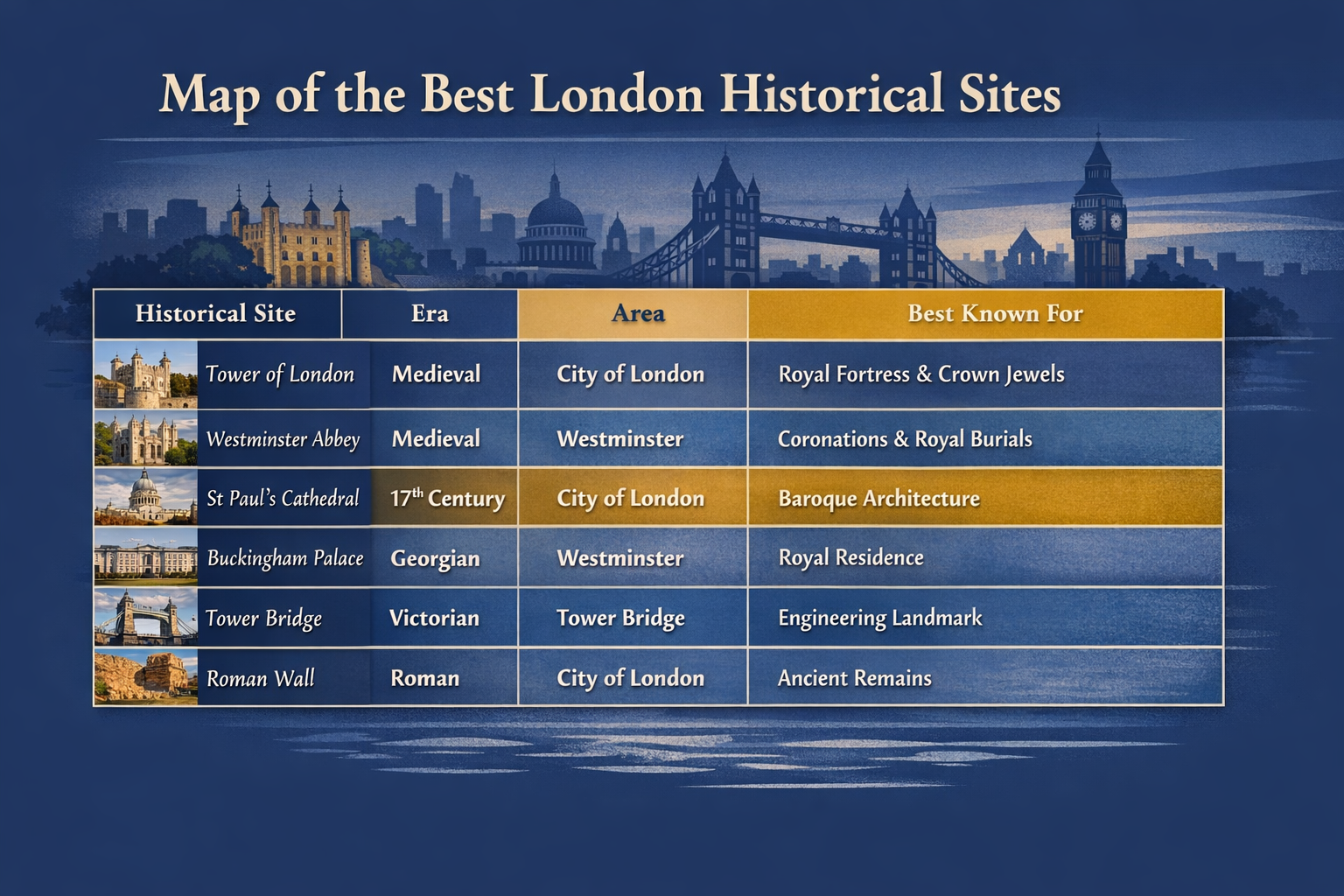 Most visitors notice something quickly. London history clusters by themes. Royal landmarks dominate Westminster. Roman and medieval remains sit in the City of London. Maritime heritage unfolds further east toward Greenwich.
Once you see the pattern, planning becomes much easier.
Royal and Medieval Historical Sites in London
Royal history sits at the centre of London’s identity. Palaces, abbeys, and fortresses shaped politics for centuries, and many still serve ceremonial roles today.
Tower of London
The Tower of London feels imposing before you even step inside. Built in 1078 under William the Conqueror, it began as a symbol of control over a newly conquered city.
Across centuries it served many roles: royal residence, treasury, armoury, prison, and execution site. Stories of Anne Boleyn, Guy Fawkes, and imprisoned princes still draw visitors.
Today the Crown Jewels remain its biggest attraction. Yet the real fascination lies in how one building reflects shifting power across English history.
Walk along the ancient walls and you start to grasp how seriously medieval rulers treated security.
Westminster Abbey
Westminster Abbey stands at the heart of British ceremonial life. Every coronation since 1066 has taken place here. Kings, queens, poets, scientists, and national figures are buried within its stone floors.
The building itself blends Gothic architecture with centuries of additions. Step inside and you notice how quiet the space feels despite constant visitors. Light filters through stained glass while memorials line nearly every wall.
Poets’ Corner alone tells a literary history lesson, honouring writers from Chaucer to Dickens.
This is less a tourist attraction and more a living historical record.
Buckingham Palace
Buckingham Palace represents modern monarchy rather than medieval rule. Originally built as a townhouse in the 18th century, it became the official royal residence during Queen Victoria’s reign.
Visitors gather daily for the Changing of the Guard ceremony, yet the building’s meaning goes deeper. It symbolises continuity between historic tradition and present-day Britain.
During summer openings, the State Rooms reveal art collections, ceremonial halls, and royal décor that reflect centuries of diplomatic and cultural exchange.
Kensington Palace
Kensington Palace offers a quieter perspective on royal life. Queen Victoria was born here, and several members of the royal family have lived within its walls.
Unlike Buckingham Palace, the atmosphere feels more personal. Exhibitions focus on private stories, fashion, and domestic routines rather than grand state occasions.
The surrounding Kensington Gardens add another layer, showing how royal spaces gradually became public parks open to everyone.
Iconic Historic Buildings and Architectural Landmarks
London history also speaks through architecture. Buildings reveal how styles changed alongside politics, religion, and technology.
St Paul’s Cathedral
Sir Christopher Wren designed St Paul’s Cathedral after the Great Fire destroyed much of medieval London. Its grand dome reshaped the city skyline and remains one of Britain’s most recognisable landmarks.
During World War II, photographs of St Paul’s standing intact amid smoke became symbols of national resilience. Climbing to the Whispering Gallery rewards visitors with sweeping views across London.
Every detail reflects craftsmanship and ambition from the late seventeenth century.
Tower Bridge
Tower Bridge often surprises first-time visitors. Many expect a medieval structure, yet it opened in 1894 during the Victorian era.
Its bascule system allowed ships to pass while maintaining road traffic, a practical solution for a growing industrial city. Inside exhibitions explain the engineering behind the moving bridge.
Glass walkways now offer views straight down to the Thames, blending history with modern visitor experience.
Palace of Westminster and Big Ben
The Palace of Westminster houses the UK Parliament and stands beside the famous clock tower commonly called Big Ben.
After a devastating fire in 1834, architects rebuilt the complex in Gothic Revival style. The design intentionally linked modern democracy with medieval tradition.
Seen from across the river, the structure feels timeless, yet it represents a nineteenth-century vision of national identity.
Trafalgar Square and Nelson’s Column
Trafalgar Square commemorates Britain’s naval victory at the Battle of Trafalgar in 1805. Nelson’s Column rises above fountains and public gathering spaces.
Over time, the square became a stage for protests, celebrations, and cultural events. That dual role as memorial and meeting place reflects how history continues to interact with everyday life.
Final Thoughts: Exploring London Through Its History
London’s history is not confined to monuments. It lives in streets, buildings, and everyday spaces you pass without noticing at first. Royal palaces, Roman remains, and Victorian landmarks all sit within walking distance, forming one continuous story.
Here’s the thing. You do not need to see everything. Pick an area, walk slowly, and let the city reveal its past piece by piece. London rewards curiosity more than rushed sightseeing.
For more travel guides and insights, visit Caledonian Travel and share your travel experiences with fellow explorers.
Frequently Asked Questions About London Historical Sites
What are the best historical sites to visit in London first?
Start with the Tower of London, Westminster Abbey, St Paul’s Cathedral, and the Palace of Westminster. Together, they explain royal history, religion, and government in one walkable route along the Thames.
What is the oldest historical site in London?
The oldest visible remains come from Roman London. Sections of the Roman Wall, built nearly 2,000 years ago, still stand in parts of the City of London.
Are London historical sites free to visit?
Many landmarks are free to view from the outside, including Buckingham Palace, Trafalgar Square, and Tower Bridge. Major interiors such as Westminster Abbey and the Tower of London require tickets.
How many UNESCO World Heritage Sites are in London?
London has four UNESCO World Heritage Sites: the Tower of London, Westminster Abbey and Palace of Westminster, Maritime Greenwich, and Kew Gardens.
Can you walk between major historical landmarks in London?
Yes. Many key sites sit along the River Thames, making it easy to walk between them in a single day with planned stops.
What is the best area in London for historical sightseeing?
Westminster and the City of London offer the highest concentration of historic landmarks, covering medieval, royal, and political history within short distances.
How much time do you need to explore London historical sites?
One full day covers the main highlights. Two to three days allow slower exploration, museum visits, and lesser-known historic locations.
Written By:
Mark Twain

Hotels at your convenience
Now choose your stay according to your preference. From finding a place for your dream destination or a mere weekend getaway to business accommodations or brief stay, we have got you covered. Explore hotels as per your mood.