Maximizing a 72-Hour Alpine Weekend: The Ultimate Chamonix Summer Itinerary
 Shah Nawaz
05 Apr, 2026
18 mins read
29
Shah Nawaz
05 Apr, 2026
18 mins read
29
Time is the primary constraint in modern travel logistics. A 72-hour weekend window provides approximately 60 hours of active, deployable time on the ground. Operating within the high Alps demands ruthless logistical efficiency. The Chamonix valley, positioned at the base of the Mont Blanc massif in the Haute-Savoie department of France, offers the highest concentration of mechanised alpine infrastructure globally. This extreme density allows for rapid vertical ascents and high-yield topographical engagement. Navigating this complex environment within a compressed timeframe requires the absolute abandonment of traditional, leisurely travel protocols. Every hour lost to transit friction, ticketing queues, or geographical disorientation directly compromises the itinerary. This document outlines the strict operational blueprint for a 72-hour summer deployment in Chamonix.
The Mathematics of Time: Public Transit versus Private Deployment
To maximise a 72-hour window, the transit phase must be treated as a tactical extraction. The arrival point is Geneva. The destination is the Chamonix valley floor. The geographical distance is precisely 82 kilometres.
The public transport matrix fails the time-poor traveller. Utilising the Swiss Federal Railways (SBB) and the French rail network (SNCF) requires boarding a train at Geneva Airport, disembarking at Geneva Cornavin, transferring to a secondary regional train to Annemasse or Bellegarde, and finally boarding the Mont Blanc Express to reach Chamonix. This multi-node transit sequence consumes up to three hours in a single direction. Adding the return leg, the traveller sacrifices six hours of a 60-hour window purely to transit mechanics. Public transport also requires manual luggage hauling across multiple platforms, inducing physical fatigue before the alpine itinerary even commences. Minor delays on the Swiss network frequently result in missed connections on the French network, expanding the time deficit further.
The mathematical solution is point-to-point transport. The protocol dictates exiting the arrivals hall and immediately boarding a pre-booked vehicle. Utilising professional airport transfers from Geneva neutralises the logistical variables. The transport asset operates strictly on the traveller's exact flight schedule. By deploying a direct Geneva to Chamonix transfer, the transit time is reduced to 75 minutes via the Autoroute Blanche. The vehicle acts as a secure mobile environment, bypassing the public transport matrix entirely and delivering the traveller directly to the accommodation threshold. This reclaims a minimum of three and a half hours over the weekend. This specific volume of saved time is the exact duration required to execute a high-altitude balcony hike.
Day 1: The Arrival and The Vertical Introduction
The primary objective for the first day is securing the basecamp and initiating the body's physiological adaptation to high altitude.
09:00 – 10:30: The Extraction Phase
The aircraft lands. Hand luggage is secured. The traveller immediately transitions from the terminal into the private transfer vehicle. The transit from Geneva to Chamonix functions as a forced rest period. Hydration must begin here to counter the dry cabin air of the flight.
11:00 – 13:00: Basecamp Establishment
Check-in at the Chamonix accommodation. The objective is immediate luggage offload and equipment configuration. The daypack must be prepared with the baseline alpine kit: a moisture-wicking base layer, a Gore-Tex outer shell, two litres of water, and broad-spectrum UV protection. No time is allocated to unpacking non-essential items.
14:00 – 18:00: Le Brévent Ascent and Altitude Adaptation
The human body requires exposure to lower oxygen saturation levels to perform efficiently on subsequent days. At 2,500 metres, atmospheric pressure drops, reducing the volume of oxygen entering the bloodstream per breath. The optimal vector for triggering the necessary physiological adaptation is the Brévent cable car system, located on the northern, Aiguilles Rouges side of the valley.
The ascent is executed in two rapid mechanised stages. The initial gondola rises from the Chamonix town centre (1,035 metres) to the Planpraz mid-station (2,000 metres). The secondary cable car scales a vertical granite face to the Brévent summit (2,525 metres). This specific altitude provides sufficient cardiovascular stimulation for day one without risking acute mountain sickness.
The primary value of Le Brévent is observational and geographical. It offers a direct, unobstructed line of sight across the valley to the Mont Blanc summit (4,809 metres). The traveller secures a geographic understanding of the terrain they will navigate on day two. The protocol requires remaining at the summit for a minimum of two hours. The traveller walks the short ridge trails, forcing the lungs to work in the thinner air, while observing the Bossons and Taconnaz glaciers opposite. A rapid descent via the cable car returns the traveller to the valley floor by 18:00.
Day 2: The High-Altitude Traverse (Grand Balcon Nord)
This is the core operational phase of the itinerary. Day two requires maximum physical output and strict logistical execution. The objective is the Grand Balcon Nord, a classic high-altitude traverse linking the Aiguille du Midi mid-station with the Mer de Glace glacier.
07:00 – 11:00: The Aiguille du Midi Ascent
The Aiguille du Midi is the highest vertical ascent cable car in the world, terminating at an altitude of 3,842 metres. It is the highest-traffic tourist node in the Haute-Savoie region. Arriving at the base station at 09:00 results in a two-hour queue. The strict protocol is to board the first cable car of the day. Depending on the summer month, this departs at 07:00 or 07:30.
The ascent is violent in its rapidity. The traveller is transported from a temperate forest valley into a high-alpine glacial environment in exactly 20 minutes. At 3,842 metres, oxygen saturation is reduced by approximately 40%. Physical movement must be deliberate, slow, and measured. The objective here is pure visual data acquisition. The traveller navigates the complex of observation decks, viewing the Vallée Blanche, the summit of Mont Blanc du Tacul, and the alpinists departing from the ice tunnel to begin their technical ascents. The traveller must spend one hour at the summit to complete the acclimatisation profile.
11:00 – 15:00: The Grand Balcon Nord Execution
The traveller descends via the cable car to the mid-station, Plan de l'Aiguille (2,317 metres). This specific coordinate is the trailhead for the Grand Balcon Nord.
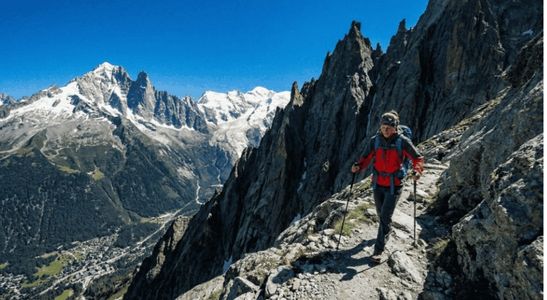
This hike is non-technical but requires sustained muscular endurance. The trail cuts horizontally across the granite flanks of the Chamonix Needles (Les Aiguilles de Chamonix). The path is a volatile mixture of compressed dirt, loose scree, and large granite slabs. Telescopic trekking poles are mandatory to distribute the physical load and maintain lateral stability on uneven ground.
The route is divided into distinct topographical sectors. The initial phase crosses ancient glacial moraines. The secondary phase enters high alpine meadows, characterised by rhododendron bushes and a high population density of alpine marmots. The trail maintains a relatively consistent elevation, undulating gently until it culminates in a short, steep, high-gradient ascent to the Signal Forbes (2,198 metres).
Signal Forbes provides the critical reveal of the day: a direct downward perspective onto the Mer de Glace (Sea of Ice), France’s largest glacier, flanked by the vertical granite walls of the Drus and the Grandes Jorasses. From this vantage point, the traveller executes a steep, zig-zagging descent to the Montenvers railway station.
15:00 – 17:00: The Mer de Glace and Mechanised Extraction
Upon reaching Montenvers (1,913 metres), the primary physical exertion phase concludes. The traveller utilises the remaining time to observe the glacial retreat markers bolted to the rock walls, which indicate the massive loss of ice volume over the past century.
The extraction from the high-altitude zone is fully mechanised. The Montenvers rack railway, a historic red cogwheel train, transports the traveller down a steep gradient through dense pine forests, terminating directly behind the main Chamonix train station. The total execution time for day two is approximately eight hours.
Day 3: Low-Impact Recovery and Seamless Extraction
The final 24 hours of the 72-hour window are strictly dedicated to lactic acid flush, low-impact topographical engagement, and the return transit to Geneva.
09:00 – 13:00: The Valley Floor Protocol
The physical output of day two necessitates a dedicated recovery period. Engaging in another high-altitude ascent or executing a steep descent risks acute joint inflammation and severe muscular fatigue, rendering the subsequent air travel highly uncomfortable. The objective is zero-gradient movement to maintain blood flow to the muscles without straining the ligaments.
The optimal route for this protocol is the Promenade des Bois or the trail to the Cascade du Dard. Both are situated on the valley floor. The Promenade des Bois routes the traveller through an ancient spruce and larch forest alongside the Arve River. The terrain is entirely flat, covered in soft pine needles and compacted earth, which acts as a natural shock absorber for the joints.
Alternatively, the Cascade du Dard requires a minor 45-minute ascent through thick woodland, terminating at a 20-metre glacial waterfall. The microclimate created by the water spray rapidly drops the ambient temperature. The traveller stops at the adjacent wooden buvette to consume hydration, observing the environment without the pressure of a ticking schedule.
14:00: The Extraction Protocol
The weekend window closes. Navigating to a central bus station or a train platform with packed luggage induces unnecessary cortisol spikes and wastes final hours. The pre-arranged private transfer vehicle arrives directly at the hotel lobby. Luggage is loaded by the operative. The traveller enters the vehicle, the doors close, and the complex alpine environment is immediately replaced by the controlled, high-speed transit back to Geneva Airport. The 72-hour window is closed precisely as the traveller arrives at the departure terminal.
Nutritional Protocols for High-Altitude Execution
Executing a high-yield itinerary requires a strict nutritional strategy. Food is operational fuel. In a 72-hour window, the traveller cannot afford to lose two hours sitting in a mid-mountain restaurant waiting for table service. The protocol requires mobile calorie consumption.
Breakfast must be secured early. The central pedestrian zone of Chamonix houses multiple boulangeries (bakeries) that open at 06:30. Prior to boarding the 07:00 Aiguille du Midi cable car, the traveller must procure high-carbohydrate provisions. Baguettes, croissants, and heavily buttered jambon-beurre sandwiches provide the necessary dense caloric load required for the Grand Balcon Nord traverse.
Hydration parameters shift drastically at altitude. The air in the high Alps is exceptionally dry. The body loses significant fluid volume simply through respiration. The traveller must carry a minimum of two litres of water at all times. Relying on mountain streams is an unnecessary biological risk. Hydration must be constant, taking small volumes of water every 20 minutes during the hike to prevent the onset of altitude-induced headaches and severe muscle cramping.
Essential Infrastructure Hacks for the 72-Hour Window
Operating within a highly compressed timeframe requires exploiting the local technological and ticketing infrastructure to bypass friction points.
The Mont Blanc MultiPass Utility
Purchasing individual point-to-point tickets for the Aiguille du Midi, the Brévent, and the Montenvers train is financially inefficient and chronologically disastrous. Ticketing queues at the base stations frequently exceed 45 minutes during the July and August peaks. The mandatory protocol is to purchase the Mont Blanc MultiPass online 48 hours prior to arrival. This pass provides unrestricted, scan-and-go access to almost the entire lift network in the valley. The traveller bypasses the central ticketing desks entirely, walking straight to the electronic boarding gates.
Meteorological Data Sourcing
Global weather applications cannot calculate high-altitude alpine microclimates. A forecast of clear skies for the Chamonix municipality often masks severe thunderstorm warnings and gale-force winds for altitudes above 2,500 metres. The traveller must download the official Chamonix application. This platform provides real-time data from weather stations located directly on the lift pylons, delivering precise wind speeds, temperature drops, and live webcam feeds. Decisions to ascend or abort an itinerary are based exclusively on this localised data stream.
The Carry-On Mandate
A 72-hour itinerary strictly prohibits checked baggage. Waiting 40 minutes at the Geneva Airport baggage carousel is a catastrophic loss of operational time. The traveller must pack exclusively in a carry-on compliant rucksack. The packing list is strictly utilitarian: one pair of trail running shoes equipped with aggressive rubber lugs (worn during transit), one high-grade waterproof shell, two moisture-wicking synthetic t-shirts, one mid-layer fleece, and ultralight hiking trousers. Cotton garments are entirely prohibited as they retain sweat and rapidly induce hypothermia during high-altitude wind exposure.
Strategic Accommodation Placement
In a standard two-week holiday, the location of the hotel within the valley is a matter of aesthetic preference. In a 72-hour window, it is a matter of tactical priority.
The Chamonix valley is entirely linear. Satellite villages such as Les Houches or Argentière offer quieter environments but require total reliance on the local Chamonix Bus network or the Mont Blanc Express train to reach the primary lift stations. Waiting 20 minutes for a delayed bus is an unacceptable operational parameter.
The accommodation must be secured directly in Chamonix Centre or Chamonix Sud. Chamonix Sud is the optimal strategic location. It is positioned directly adjacent to the Aiguille du Midi base station. Securing a hotel or apartment within this specific grid allows the traveller to wake up at 06:30, secure provisions, and walk to the lift boarding zone in under four minutes. It eliminates the requirement for secondary early morning transport.
By strictly adhering to these geographical, logistical, nutritional, and structural protocols, the traveller extracts the maximum possible yield from a 72-hour alpine window. The environment is engaged with absolute precision, the transit friction is mathematically reduced to zero, and the primary objectives are secured.
Written By:
Shah Nawaz

Hotels at your convenience
Now choose your stay according to your preference. From finding a place for your dream destination or a mere weekend getaway to business accommodations or brief stay, we have got you covered. Explore hotels as per your mood.