Morocco eVisa for Comoros
 John Smith
06 Nov, 2025
27 mins read
76
John Smith
06 Nov, 2025
27 mins read
76
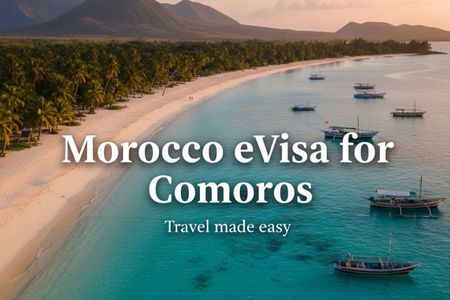
Planning a trip from the beautiful islands of Comoros to the vibrant landscapes of Morocco? You are in for an amazing journey! But before packing your bags and booking your flights, it is smart to get familiar with the travel document process, especially the Morocco eVisa. This article gives you a friendly, detailed guide on everything you need to know, with a focus on the specific case of Morocco eVisa for Comoros travellers. Lets dive in, step by step, so you feel confident and ready.
Why do Comoros citizens need a Morocco eVisa?
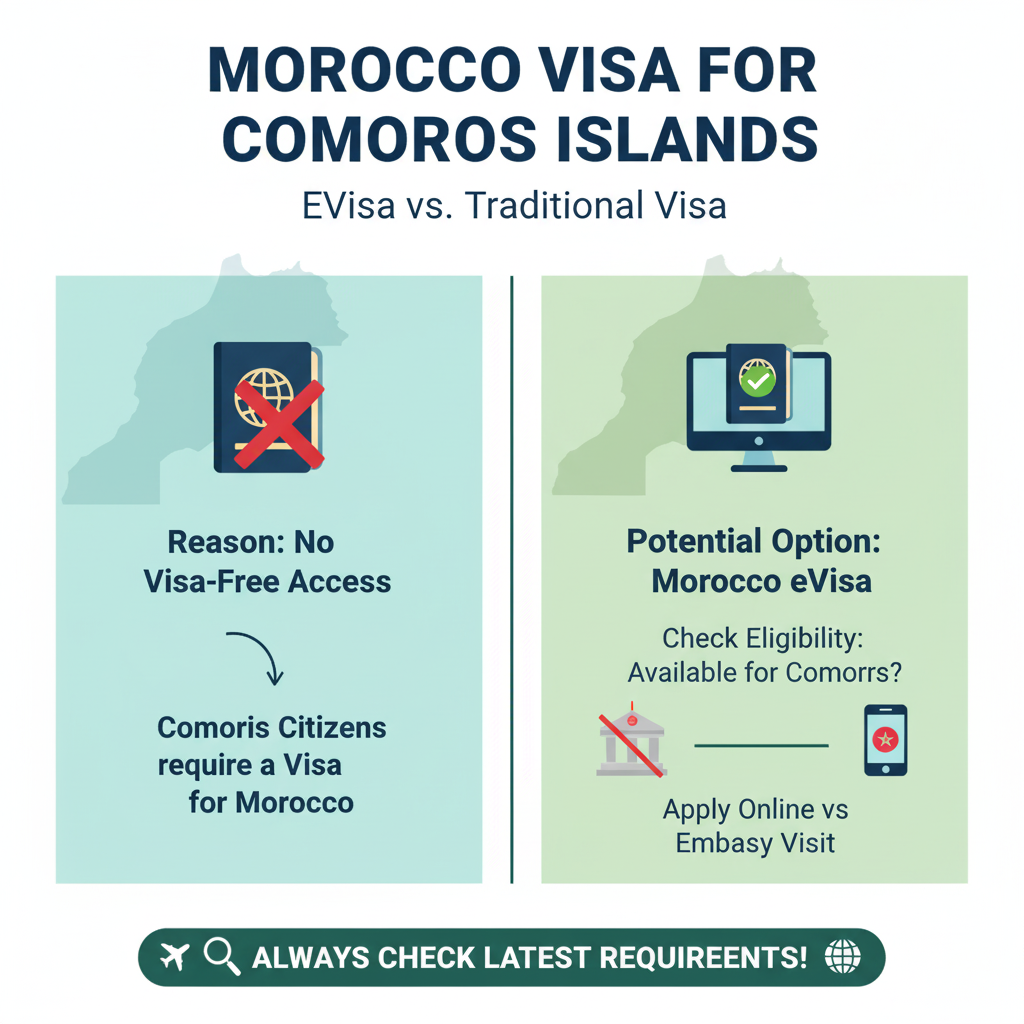
If you hold a passport from Comoros and want to visit Morocco, you may find that you are not eligible for visa-free access. According to available travel-requirement sources, Comorian nationals must obtain a visa for Morocco rather than enjoying full exemption. With the introduction of the Morocco eVisa system (see below), some travellers from eligible countries can apply online instead of visiting a mission in person. However, it is important to check whether Morocco eVisa for Comoros specifically is available or whether the regular visa process still applies.
Who is eligible for a Morocco eVisa from Comoros?
When we talk about Morocco eVisa types and eligibility, key factors include your nationality and what other travel or stay documents you may hold. The general rule for Moroccos system is: citizens of certain countries can apply for the eVisa directly, while others must go through a traditional visa process.
For Comoros nationals specifically, recent sources suggest that you must apply for a conventional visa rather than an eVisa, indicating that Morocco eVisa for Comoros might not be available yet through the online channel.
How can Comoros residents apply for a Morocco eVisa online?
Assuming you are eligible for an eVisa (or will be shortly), heres the step-by-step friendly guide to apply for Morocco eVisa:
- Prepare your passport and travel plan – Make sure your passport is valid (typically at least six months beyond your intended arrival in Morocco). For standard visas, that is required.
- Select the application type – Choose the appropriate Morocco eVisa type from the options.
- Fill out the form – Provide your personal details, travel dates, purpose (tourism, business, etc.), and upload requested documents (photo, passport scan, travel itinerary).
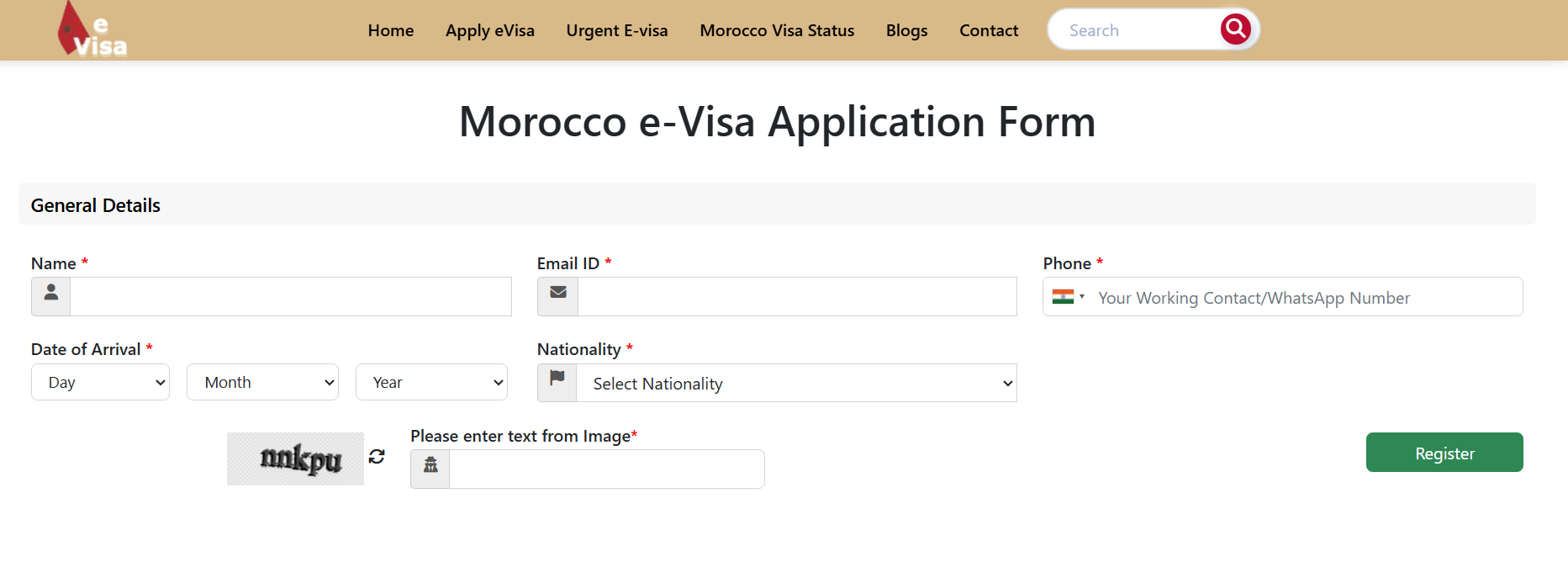
- Pay the application charge – The payment can be done online via card or otherwise, if eligibility conditions permit.
- Submit and wait for approval – After submission, you will receive an email confirmation. Once approved, the eVisa will be delivered electronically.
- Print or save approval – Ensure you carry a printed copy or digital version on your device when you travel.
- Travel to Morocco – At arrival, present your passport, printed eVisa approval (if required) and any additional documents.
Important: Since Morocco eVisa for Comoros may not yet be open to Comoros nationals via the online route, you may need to apply for a traditional visa process in person.
What documents are required for a Morocco eVisa for Comoros citizens?
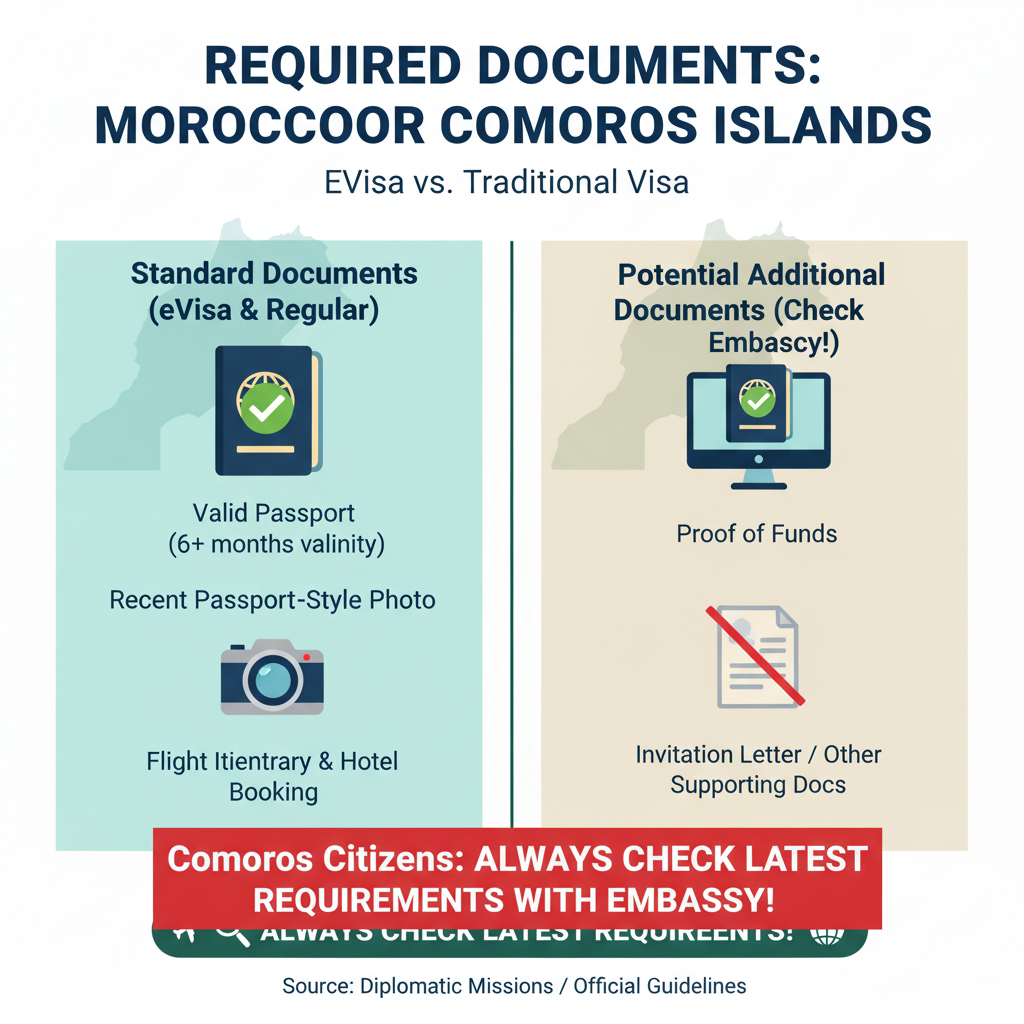
Even when applying for the online version, you will typically need these required document for Morocco eVisa (and for the regular visa route they apply too):
- A valid passport with at least 6 months validity beyond your planned arrival.
- A recent passport-style photograph.
Since the case of Comoros nationals may not fall under the straightforward eVisa eligibility, you might be asked for extra documents by a Moroccan diplomatic mission. Always check with the local representation.
What is the cost of a Morocco eVisa for Comoros citizens?
While I could not locate a public, country-specific fee schedule for Morocco eVisa for Comoros travellers, general information about the system gives context. For example, some sources indicate that the online eVisa is a simpler application but still carries a service fee. By contrast, for the regular visa route to Morocco, sources indicate variable charges depending on nationality, type of stay and number of entries.
Given this, if you are applying and Comoros nationals must use the regular route, expect that the Morocco eVisa fee may vary and your local Moroccan representation will provide the exact amount. it is best to check directly and budget accordingly.
What types of Morocco eVisas are available for Comoros travelers?
When discussing Morocco eVisa types, it is helpful to know the categories that the Moroccan authorities currently offer:
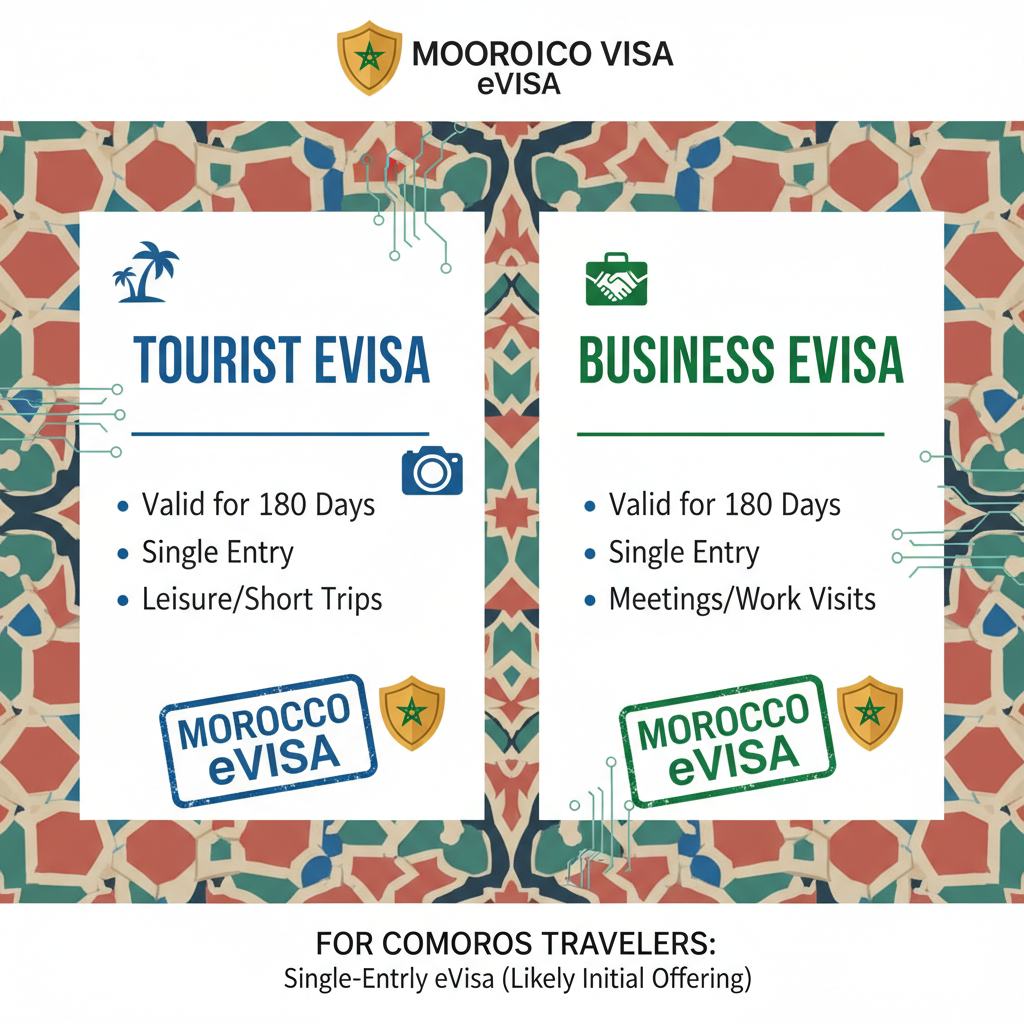
Tourist eVisa:
- Valid for 180 days
- Allows Single Entry
- Typically for leisure or short-term travel purposes
Business eVisa:
- Valid for 180 days
- Allows Single Entry
- Intended for business meetings, conferences, or work-related visits
Both visas offer the same validity and entry type but serve different purposes.
For you as a Comoros passport-holder, if the Morocco eVisa for Comoros becomes available, you will likely be looking at a single-entry eVisa initially. If not, then you will apply via the traditional visa route.
How often do Comoros citizens need to renew their Morocco eVisas?
The term renew in the context of eVisas is a bit unusual: typically you apply for a new eVisa when your validity expires rather than renew it. For eligible eVisas for Morocco:
- The eVisa might be valid for a fixed period (for example up to 180 days from issue) and allow a stay of up to 30 days.
- Once you have used the stay or the validity lapses, youd apply again for a new one if you want to travel again.
So for a Comoros citizen: if you manage to obtain the Morocco eVisa, you will check the validity given (issue-to-expiry) and when your stay ends. If you need another trip later, you will apply afresh.
How long does it take for a Morocco eVisa to be approved for Comoros residents?
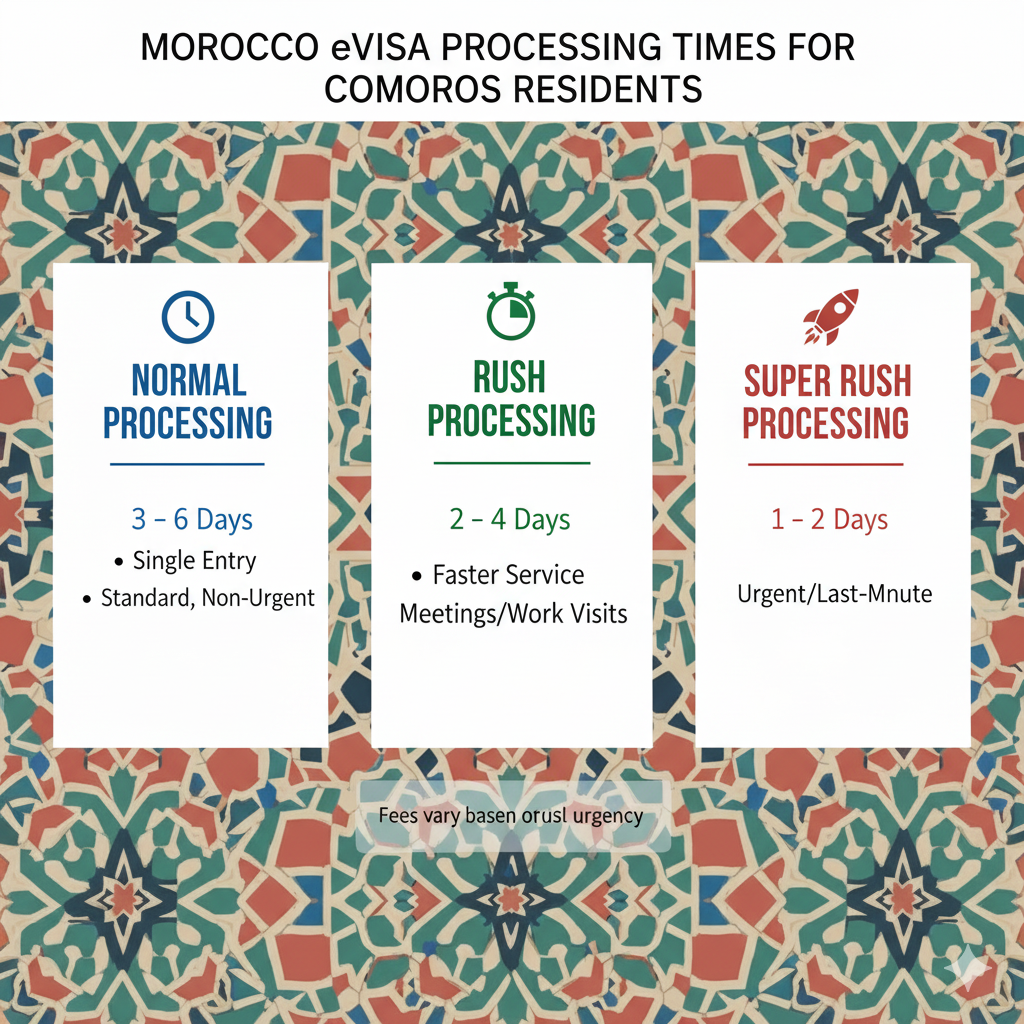
Users can choose the preferred processing speed for their application.
Options Available:
- Normal Processing: Takes 3 – 6 days; ideal for applicants who do not require urgent service.
- Rush Processing: Takes 2 – 4 days; suitable for faster results within a shorter period.
- Super Rush Processing: Takes 1 – 2 days; best for urgent or last-minute needs.
Each option offers different turnaround times, likely with varying fees based on urgency.
Who can assist Comoros travelers with their Morocco eVisa application?
Here are some helpful contacts and resources:
- The Moroccan diplomatic mission or visa-centre responsible for Comoros nationals. Examples show in Nairobi may cover some regional nations.
- Accredited visa-service providers specialising in Morocco travel documentation.
- Travel agents or tour operators who help with Morocco travel might also guide you through the document gathering.
- The online eVisa portal (for eligible nationalities) provides FAQs and help lines.
Having assistance is particularly helpful if your nationality is not straightforward eVisa-eligible (as seems the case), so a guided approach can save you time and avoid errors.
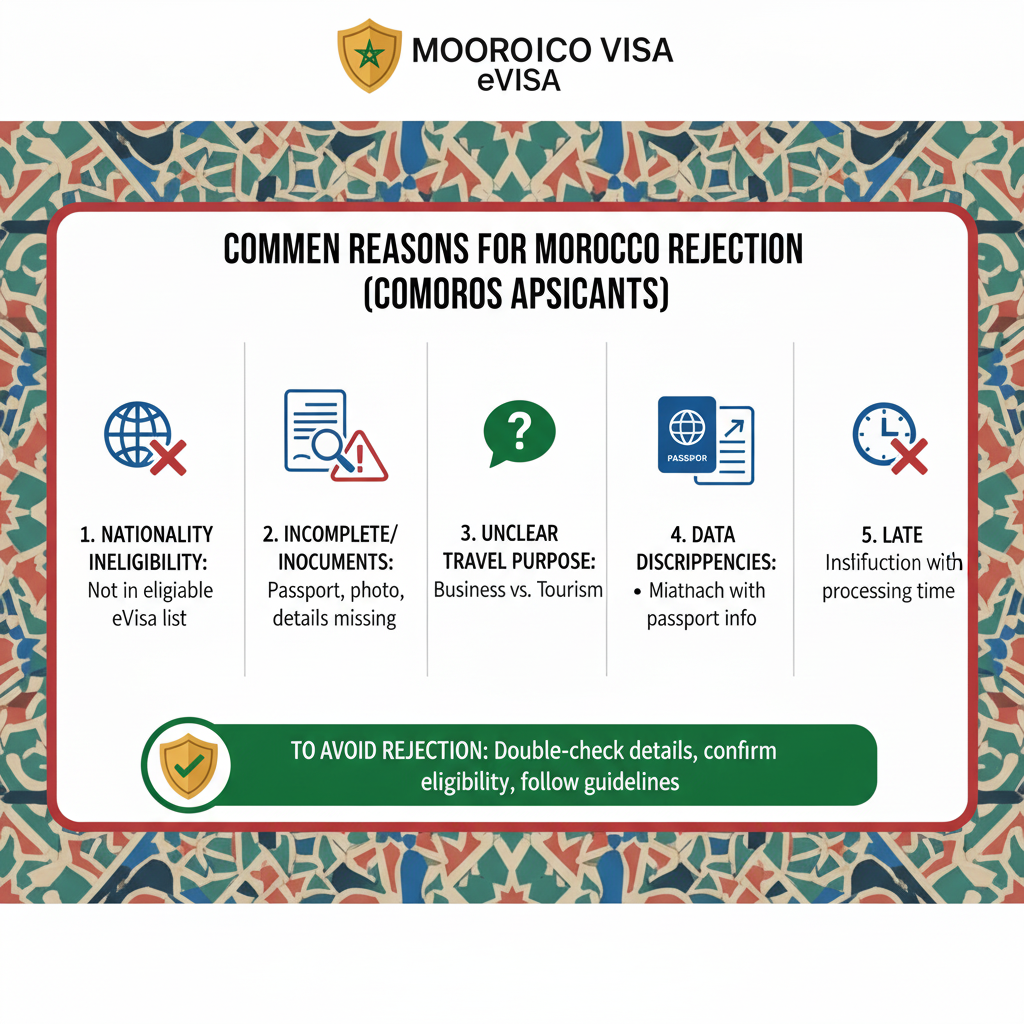
Why might a Morocco eVisa application be rejected for Comoros applicants?
There are several reasons applications can be declined or delayed:
- Your nationality (Comoros) may not currently be eligible for the eVisa category, and you applied as if it were.
- Incomplete or incorrect documentation (passport validity too short, missing photo, insufficient travel details).
- Travel purpose not clearly stated or supported (e.g., business vs tourism).
- Discrepancies between submitted data and passport information.
- Applying too late or not giving enough lead time for processing.
To avoid rejection: double-check all details, ensure you meet the eligibility rules, and follow any nationality-specific advice for Comoros travellers.
How do Comoros citizens extend their Morocco eVisas?
Extension policies: For eligible eVisas, you might be able to extend your stay while in Morocco under certain conditions (this often involves applying locally and meeting criteria). Some sources say a single-entry eVisa may allow extension up to 6 months. For Comoros passport-holders applying via conventional visa route, extension will depend on Moroccan administrative rules and may require a local application and justification. If you think you will need a longer stay, it is safe to plan for the maximum allowed stay at application time and avoid relying on extension.
When does the Morocco eVisa for Comoros become valid?
For the standard eVisa process (for eligible nationalities), validity typically starts from the issue date and remains valid for a specified period (for example up to 6 months / 180 days) for you to enter. Stay length might be up to 30 days.
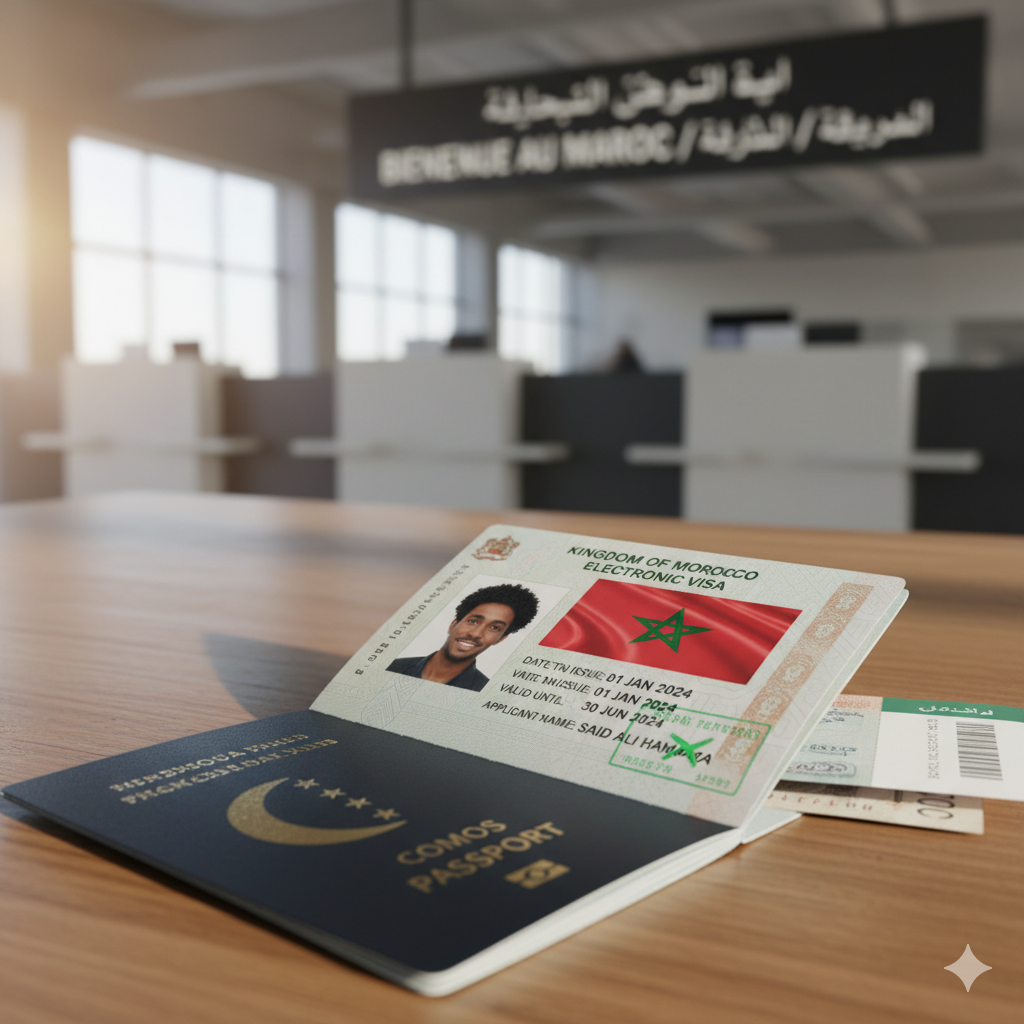
For your situation (Comoros nationals), if you receive a visa via the diplomatic channel, validity will be specified on the visa sticker or document: it will note how long you can enter before and how long you can stay. Always check the dates.
What are the entry rules for Comoros citizens with a Morocco eVisa?
If you obtain the appropriate travel document:
- Arrive at a designated port of entry in Morocco with your passport and approval/visa.
- Present your printed eVisa approval (if you used the eVisa route) or visa sticker.
- Ensure your stay does not exceed the allowed length (e.g., 30 days).
- You may be asked for supporting documents such as an onward ticket or proof of accommodation.
- Follow Moroccos border control rules, including passport validity, any health/travel checks.
Because Morocco eVisa for Comoros may not be fully available online yet, check carefully whether you will have an eVisa or a regular visa, and follow the rules accordingly.
Where can Comoros nationals check the status of their Morocco eVisa?
For the eVisa route, once you submit your application online, you will receive a confirmation code and you can use the portal to check application status.
If you are going through the conventional visa channel, you may need to contact the visa-centre where you applied, using your reference or tracking number, to see if your document is ready or any additional steps are required.
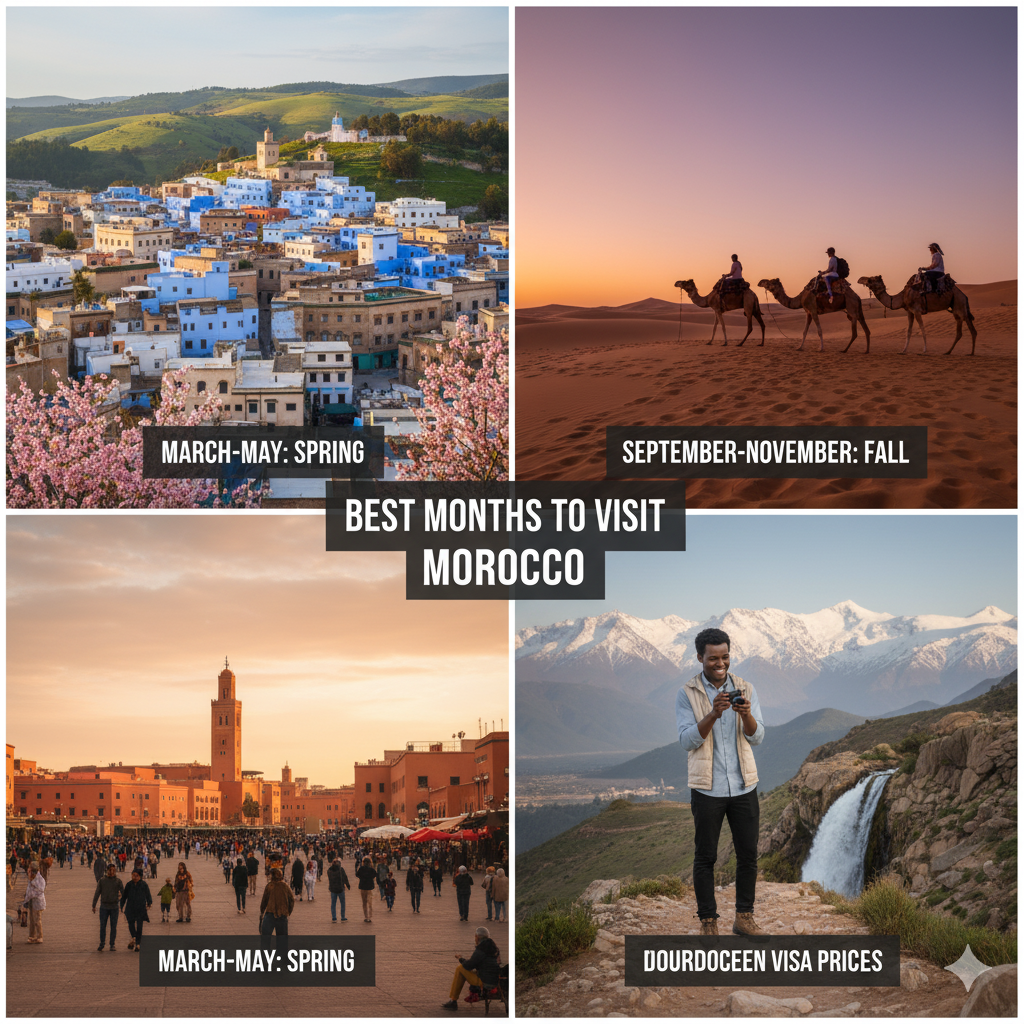
What is the best month to visit Morocco?
Travel-friendly tip: Morocco offers very pleasant weather from March to May (spring) and from September to November (fall). During these months, the climate is mild, fewer crowds, and ideal for exploring cities like Marrakech, Fes, and Casablanca, as well as desert and mountain regions. Visiting in summer can be hot, especially inland; winter may bring rain in the north and cold nights in the desert. So if you are a Comoros traveller planning your Morocco adventure, aim for spring or fall for optimal comfort and travel experience.
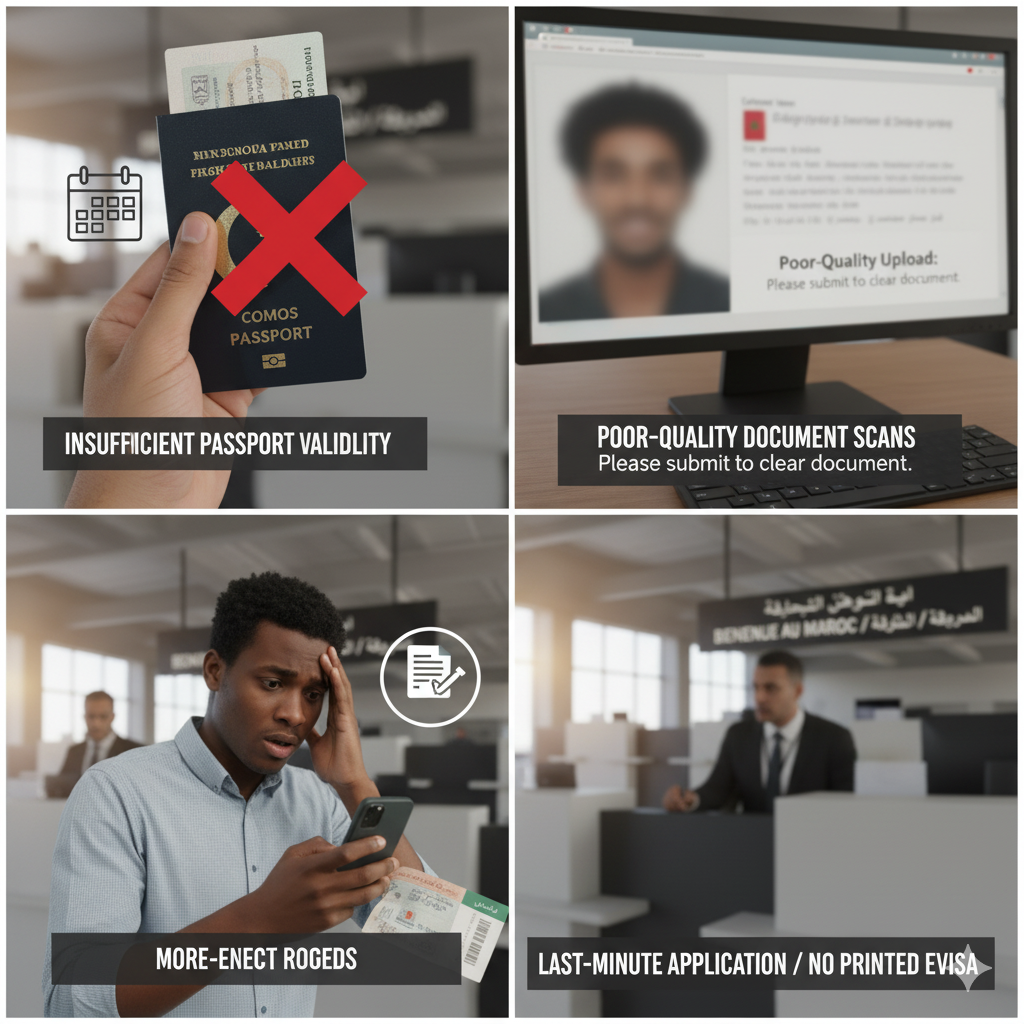
What are the common mistakes Comoros citizens make while applying for a Morocco eVisa?
Here are some pitfalls to watch out for:
- Assuming Morocco eVisa for Comoros is available when it may not yet be, you might need to apply via a mission instead.
- Submitting the passport with insufficient validity (less than required months beyond arrival).
- Uploading poor-quality scans or photos (blurry picture, missing information).
- Leaving the application to the last minute and not leaving buffer time for processing.
- Not checking whether your travel purpose matches the eVisa type applied (tourism vs business).
- Misreading entry-or-stay lengths and accidentally overstaying.
- Not saving or printing the approval document, or failing to present it upon arrival.
- Forgetting to carry accommodation or onward-ticket details that may be asked at border control.
What are the top tips for Comoros applying for a Morocco eVisa online?
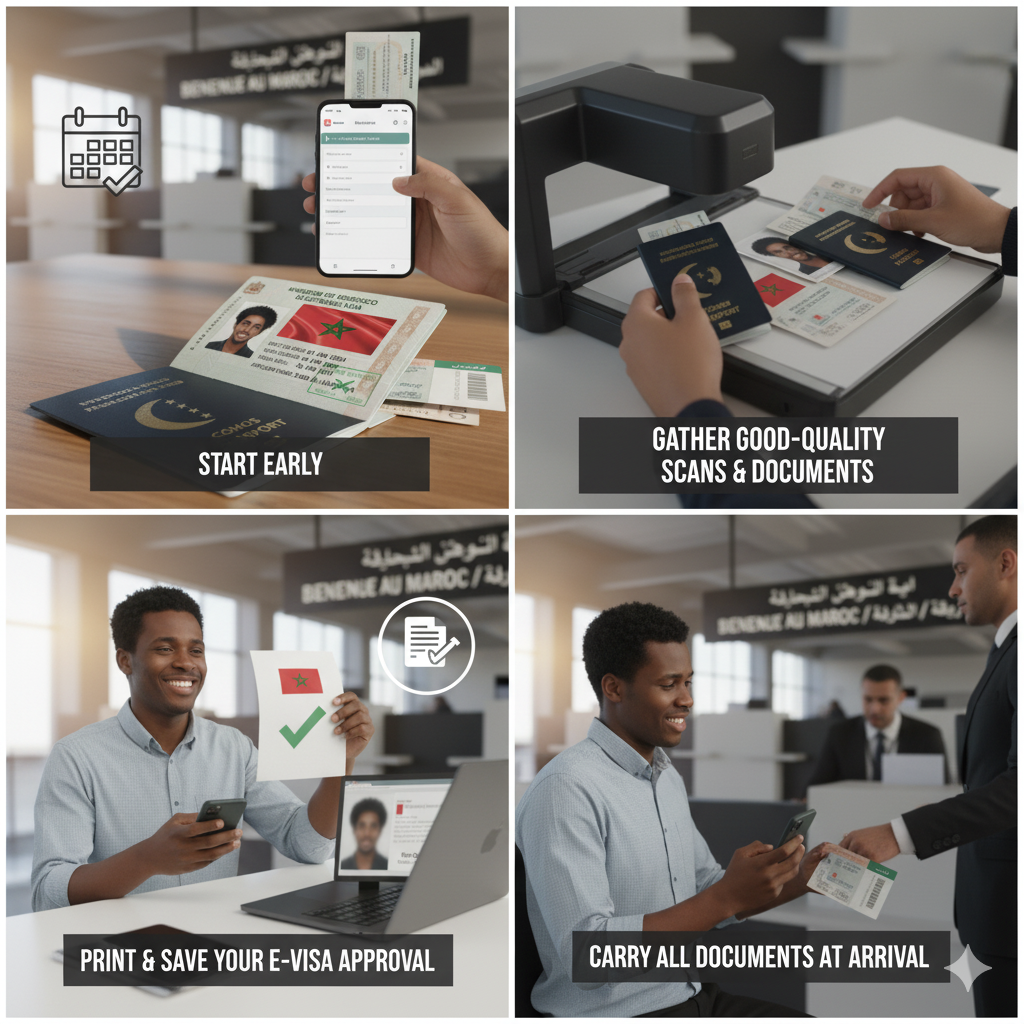
- Start early! Even if your nationality must use a regular visa route now, check if changes apply and prepare ahead.
- Gather good-quality scans of your passport, photo, and travel details before beginning the online application.
- Double-check your nationality eligibility, ask the nearest Moroccan representation to confirm if eVisa is supported for Comoros citizens.
- Read the detailed instructions for Morocco eVisa types so you pick the correct category (single-entry, multiple-entry, etc.).
- Keep copies of all documents and your application reference number.
- Once approved, save a printed version of the eVisa approval (if applicable) and keep a digital backup.
- At arrival in Morocco, carry your passport, printed approval, hotel or accommodation confirmation, and return/onward ticket.
- Respect the validity and stay period. Overstaying can affect future travel.
- Stay informed of any changes in rules (as countries often update lists of eligible nationalities or change online systems).
- Enjoy planning your trip! Morocco is rich in culture, scenery, and adventure, your travel document is just the first step.
Conclusion: Smooth Travel Experience Awaits You
Embarking on your journey from Comoros to Morocco is exciting, and with the right preparation around the Morocco eVisa, you will be on your way with confidence. Although Morocco eVisa for Comoros may still require using the regular visa process rather than the fully-online route, knowing all the steps, requirements, and tips helps you avoid surprises. Whether you are drawn to the bustling souks of Marrakech, the blue-shaded streets of Chefchaouen, or the desert dunes near Merzouga, proper planning ensures your entry is smooth and stress-free. Use this guide to check your eligibility, choose the right type, gather your documents, and apply with ease. Your Moroccan adventure awaits, enjoy every moment, and travel smart!
Morocco eVisa FAQs for Comoros residents
Q1: Can I apply for a Morocco eVisa for Comoros directly online?
A1: At present, sources suggest Comoros nationals must apply for a traditional visa rather than the online eVisa. Double-check with Moroccan representation for the latest eligibility.
Q2: How long will my stay be if I get a Morocco eVisa?
A2: For eligible nationalities, the eVisa stay edge is up to 30 days typically. The online visa validity may be up to 180 days for entry.
Q3: What if I arrive in Morocco and my stay is longer than permitted?
A3: Overstaying is not advisable. If you think you will need more time, check in advance whether extension is possible. For eVisas it may be allowed under certain conditions.
Q4: Who do I contact if my Morocco eVisa application is delayed or rejected?
A4: For eVisa you should use the online portals help or customer support. For traditional visa, contact the Moroccan mission or visa service provider with your reference number.
Q5: Is the visa process expensive?
A5: Fees vary by nationality, type of entry and number of entries. Since Comoros nationals likely use the traditional route, find out the specific fee from your nearest Moroccan representation.
Written By:
John Smith

Hotels at your convenience
Now choose your stay according to your preference. From finding a place for your dream destination or a mere weekend getaway to business accommodations or brief stay, we have got you covered. Explore hotels as per your mood.