Photo Specifications and Guidelines for Romania Visa Application
 Richard Moore
24 Oct, 2025
23 mins read
653
Richard Moore
24 Oct, 2025
23 mins read
653
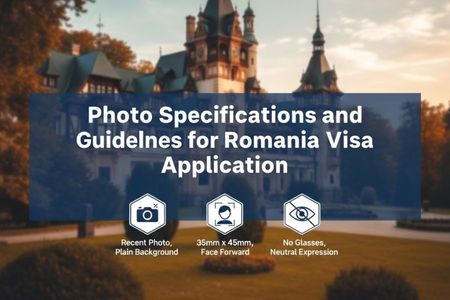
A photo is one of the most significant factors that should be considered when requesting a Romania eVisa but one that is frequently neglected. It has been noted that many applicants are either delayed or rejected just because their photo is not of the required specifications. Knowing the correct instructions will help you to save a lot of unnecessary troubles and simplify your process of gaining an e Visa.
Photo Specifications for Romania Visa
The Romanian e-visa authorities have stipulated the specifications of the kind of photo you should provide when you are applying the visa. These are the mechanisms to make your photograph clear, professional and easily recognizable.
1. Photo Size
- Dimensions: The required size for the photo is 35mm x 45mm (1.37 inches x 1.77 inches). This is the standard passport photo size used by many countries around the world.
- Face Proportion: Your face should take up around 70-80% of the total photo. This means the height of your face, from chin to crown, should be between 32mm and 36mm.
This makes your face the center of the picture, and this is essential in terms of identifying a person.
2. Background
- Plain and Light-Colored: The background of your photo must be plain white or light-colored. Colors such as light grey or cream are acceptable as well.
- No Patterns or Shadows: Avoid any backgrounds with shadows, patterns, or objects. The plain, solid background allows the focus to remain entirely on your face.
- No Text or Marks: There should be no text, logos, or markings visible in the background of your photo.

3. Face and Expression
- Neutral Expression: You must maintain a neutral expression in your photo. Your mouth should be closed, and your eyes should be open.
- Do not smile, frown, or make any exaggerated facial expressions.
- Directly Facing the Camera: Your head must be directly facing the camera, with your face in full view. Slight tilts of the head are not allowed, as this can distort your appearance.
- Head and Shoulders: The photo should capture both your head and shoulders, with your head positioned centrally in the frame.
4. Eyes
- Visibility: Your eyes must be clearly visible. If you wear glasses, make sure that there is no glare or reflection that obstructs your eyes.
- No Sunglasses or Tinted Glasses: You should not wear sunglasses or tinted glasses in the photo. Even if you wear prescription glasses, ensure they do not block your eyes or cause any reflection.
- No Eye Makeup or Accessories: Avoid excessive eye makeup or any accessories that might cover or obstruct your eyes (e.g., hair bangs or jewelry).

5. Headgear
- Headgear for Religious or Medical Reasons: You may wear head coverings such as a scarf, turban, or other headgear if it is for religious or medical purposes. However, the head covering must not obscure any part of your face, including the chin, forehead, or cheeks.
- No Fashion Accessories: Hats, caps, or other fashion accessories are not permitted unless they are worn for religious reasons.
- Clear Visibility of the Face: The most important rule is that the face must be completely visible from the bottom of the chin to the top of the forehead, including both sides of the face. Your face must not be hidden by the headgear in any way.
6. Clothing
- Neutral or Contrasting Colors: You should wear clothing that contrasts with the background. While there are no strict rules about the exact color of your attire, wearing a dark-colored shirt or top is often recommended to help distinguish you from the light-colored background.
- Avoid Uniforms or Camouflage: Do not wear any uniforms, military attire, or camouflage clothing in the photo. Such clothing can give a misleading impression, so it is better to opt for casual or formal attire.

7. Photo Quality
- Sharpness and Clarity: The photo should be sharp with clear, distinct features. Any blur, pixelation, or distortions are unacceptable.
- No Filters or Retouching: The photo should be natural. Do not apply any filters or digital alterations. This includes excessive lighting adjustments, color enhancements, or smoothing effects that could change your natural appearance.
- Adequate Lighting: Ensure that the lighting in the photo is even. Avoid harsh shadows or overexposure, especially around the face. Soft, natural lighting is ideal.
8. Recent Photo
- Taken Within the Last 6 Months: Your photo must be recent, typically taken within the last 6 months. This ensures that your appearance is current and accurately represents how you look at the time of your visa application.
Can I Use a 2x2 Photo for a Schengen Visa?
A photo of a passport size is one of the crucial requirements when one applies to get a Schengen visa. Nevertheless, the requirements of this photo are not typically taken care of especially on the aspect of dimensions. The question, which is frequently posed is the following: Can I use a 2x2 photo in a Schengen visa?
The short answer is: No. A 2x2 photograph is not a normal size of application of Schengen visa, but it is commonly used in other documents, like U.S. visa. In case of a Schengen visa, the photo aspect is very particular and the application of 2x2 photo can lead to your application being postponed or denied.
Why is the 2x2 Photo Not Accepted?
U.S. visa applications are usually done on a 2x2 photo that is not applicable to the Schengen visa which has stringent requirements. The size of the 2x2 picture is just slightly bigger than the size that a Schengen visa needs, and that may not be a great difference but even the slight deviations may lead to rejection of your visa request.
Additionally, the photo images to be used in Schengen visas should be accurately sized and formatted to make sure that the facial features are visible, well placed and can be easily identified in all Schengen Area member countries.
What Happens if I Submit a 2x2 Photo for My Schengen Visa Application?
When you apply for Romania eVisa using a 2x2 photograph, your application can be postponed or cancelled. You to provide a new photograph that satisfies the Schengen visa photo. This may lead to a lot of delays in obtaining your visa especially when you are in a strict schedule to travel.

Tips for Getting the Perfect Schengen Visa Photo
To avoid any issues with your photo, it’s a good idea to:
- Visit a Professional Photographer: Many photographers are familiar with the specific requirements for visa photos. They can ensure that your photo is the correct size and meets all other specifications.
- Check the Guidelines: Before you have your photo taken, visa photo requirements on your country’s embassy or consulate website. This will help you avoid any mistakes.
- Use an Online Photo Tool: Some websites and apps allow you to upload your photo and adjust it to the correct dimensions for Schengen visa applications. Make sure to cross-check the final result with the guidelines to ensure accuracy.
What is the Romania Visa Rejection Rate?
The visa rejection rate is a critical element that applicants should have when seeking a visa to Romania. Visa rejection rate is the percentage of rejected visa applications expressed as a ratio of all the visa applications made.
Romania Visa Rejection Rate Overview
The rejection rate of the visa of Romania will also depend on various factors, such as the kind of visa being applied for, the nationality of the applicant and the quality of the application that has been done. Romania is in the European Union (EU) and even though the country is currently not a Schengen Area member, visa processing of the state is more or less in line with the EU and Schengen standards.
Factors Influencing Romania Visa Rejection Rates
- Incomplete Documentation: One of the leading causes of visa rejection is submitting incomplete or inaccurate documents. It is crucial for applicants to provide all the required paperwork, such as a valid passport, proof of financial stability, and travel insurance.
- Financial Instability: Applicants must demonstrate that they can financially support themselves during their stay in Romania. If consular officers feel that the applicant lacks sufficient funds, this can lead to rejection.
- Travel History: A strong travel history, especially within the Schengen Area, can work in favor of an applicant. Individuals with a history of overstaying in previous countries or having a poor immigration record may face higher rejection rates.
- Purpose of Visit: Applicants must clearly state the purpose of their visit (tourism, business, study, etc.) and provide supporting documents that align with the stated purpose. Any suspicion regarding the true purpose of the visit can increase the likelihood of rejection.
- Nationality: Citizens from certain countries, particularly those with a history of irregular immigration or high levels of visa abuse, may face a higher rejection rate. It is advisable to check the specific visa requirements and rejection statistics for your nationality before applying.
- Security Concerns: In some cases, visa applications may be rejected due to concerns related to national security. This typically affects applicants from countries experiencing political unrest or conflict.

Romania Visa Rejection Rates by Nationality
The Romania visa rejection rate is more in certain countries based on a number of reasons, which include the political instability, bad diplomatic relations, or illegal immigration fears. On the contrary, citizens of the EU and the Schengen Area countries, and countries that have a good diplomatic relationship with Romania tend to have a lower rate of rejection.
As an example, the citizens of such countries as India, Bangladesh, Nigeria, and some of the Middle Eastern countries can experience increased rates of rejection owing to the increased rate of visa abuse or abnormal immigration trends in these countries.
Conversely, applicants with EU citizenship, US, Canada, Australia, and Japan, tend to have an easier time in visa application with less chances of rejection.
Mistakes to Avoid
- Sending self-photos or informal social media photos.
- With old photographs of over six months.
- The use of colored or patterned backgrounds.
- The face is in poor light or shadowed.
- Using glasses that have colored lenses or refractive glasses.

Conclusion
It is important to make sure that your photo on a visa is in accordance with the strict Romania rules during the visa application. With proper adherence to the given specifications, i.e. the correct photo size, neutral expression, proper background, and other specifics, you will not have to encounter any undue delays and make sure that your application is processed without any complications.
FAQs
Q1: Am I allowed to wear glasses in my photo during eVisa to Romania?
A: Yes, it is okay to wear glasses, and make sure that your eyes are completely visible, and not reflected on glasses.
Q2: Is a selfie an option when taking eVisa photo?
A: No, there are no recommendations of selfies or informal photos. It needs a fine image that has been taken professionally or is just framed and in a transparent image.
Q3: Which background colors are permitted?
A: It should have plain and light-colored backgrounds like white or light grey.
Q4: When was my photo updated?
A: You have to take your photo in the past six months to be able to demonstrate how you currently look.
Q5: Is it possible to wear a hat or scarf in a photo?
A: No hats and scarfs except when worn on religious grounds and at that, your faces have to be completely exposed.
window.NREUM||(NREUM={});NREUM.info={"beacon":"bam.nr-data.net","licenseKey":"NRJS-3109bb2e2783f515265","applicationID":"558315209","transactionName":"blUHbEVQCxECBUVQWVcfMEpeHhARBhRCFlRVXwIXVEMAAxcDU1VZXh4VUEc=","queueTime":0,"applicationTime":139,"atts":"QhIEGg1KGB8=","errorBeacon":"bam.nr-data.net","agent":""}
Written By:
Richard Moore
Hotels at your convenience
Now choose your stay according to your preference. From finding a place for your dream destination or a mere weekend getaway to business accommodations or brief stay, we have got you covered. Explore hotels as per your mood.