Planning a Multi-Country Trip Morocco, Cameroon, Congo & Egypt Travel Guide
 Noah Williams
19 Nov, 2025
32 mins read
87
Noah Williams
19 Nov, 2025
32 mins read
87

Planning a Multi-Country Trip Morocco, Cameroon, Congo & Egypt Travel Guide
The continent of Africa is a world of contrasts, from the timeless Sahara to the dense equatorial rainforests, and from ancient pharaonic monuments to vibrant modern cities. While most travelers choose a single region, a journey spanning Morocco, Cameroon, the Republic of the Congo, and Egypt is an unparalleled adventure, a chance to witness North, Central, and West African cultures in a single, epic itinerary.
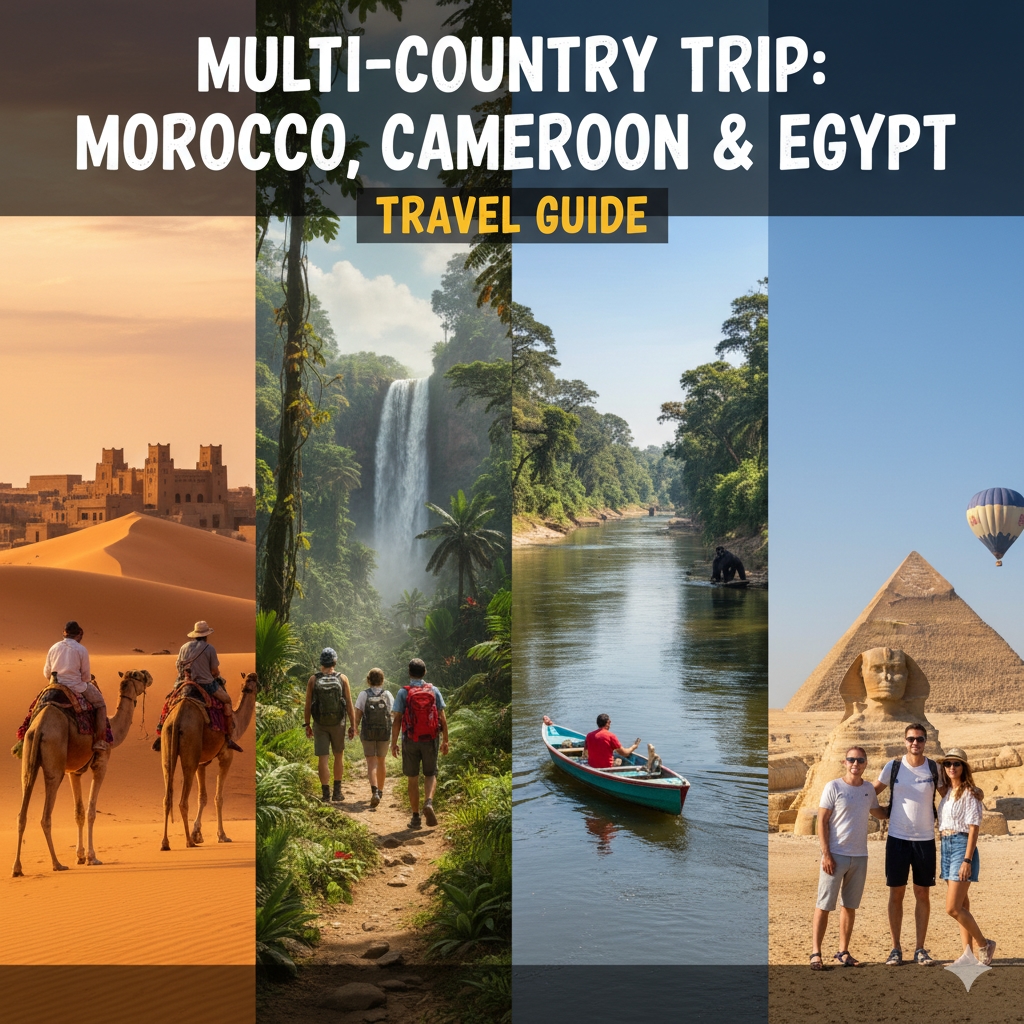
This is not a simple hop-skip trip, it's an ambitious undertaking that requires detailed planning, but the reward is an encyclopedic understanding of Africa's diversity. This comprehensive guide breaks down the essential logistics, costs, and must-see destinations to turn this dream into a reality.
What Are the Essential Visa and Entry Requirements for This Multi-Country African Trip?
This section serves as your administrative blueprint, defining the necessary pre-departure authorizations required for smooth entry into Morocco, Cameroon, the Republic of the Congo, and Egypt. It encompasses the standardized requirements, including the legal documentation, financial proof, and timeframes necessary to secure an electronic or traditional visa, ensuring compliance with each nation's immigration laws.
Core Elements of Entry Compliance:
- Visa Type and Purpose: You must determine the correct category (Tourist, Business, Transit) based on your intended activities in each country, as this dictates the application process.
- Passport Validity: Your passport must meet the non-negotiable standard of typically six months validity beyond your date of entry into the first African country.
- Proof of Exit: You must provide concrete evidence of onward or return travel (booked flights) to confirm you do not intend to overstay your authorized duration.
- Financial Proof: You are required to demonstrate adequate funds to cover your stay, usually evidenced by recent (last 30-day) bank statements or a letter of guarantee.
- Health and Safety: Compliance with mandatory health requirements, such as the Yellow Fever Vaccination Certificate (ICV), which is crucial and often required for entry into Cameroon and the Republic of the Congo.
Why Prioritize the eVisa for this Journey?
Choosing the electronic visa (eVisa) is the preferred strategy for this multi-country itinerary due to its certainty and administrative control, especially when traveling through regions with varied entry requirements.
- Guaranteed Certainty Before Departure: The eVisa provides pre-approval and eliminates the risk of being denied entry upon arrival. This certainty is non-negotiable for flights into Central Africa, where airlines will strictly deny boarding without proof of a valid, pre-secured visa.
- Mandatory for Central Africa: Unlike Egypt, which offers Visa on Arrival (VoA), both Cameroon and the Republic of the Congo strictly require pre-arranged entry permits. The eVisa is the simplest way to secure this authorization without visiting an embassy.
- Smoother Border Control: With the eVisa, the traveler has already submitted all documentation and payment online. Upon arrival, immigration simply verifies the pre-approved document, leading to a faster and more efficient process at the port of entry.
- Centralized Documentation: The entire application—from photo submission to payment—is handled digitally through a single online portal, making it easier to track and manage the four different applications required for this trip.
What is the Essential eVisa Document Checklist the Must-Haves?
All eVisa applications, regardless of the country, require the following core documents, which must be uploaded to the official government portal. It is crucial to adhere strictly to the format and quality specifications, as minor errors are the leading cause of application rejection.
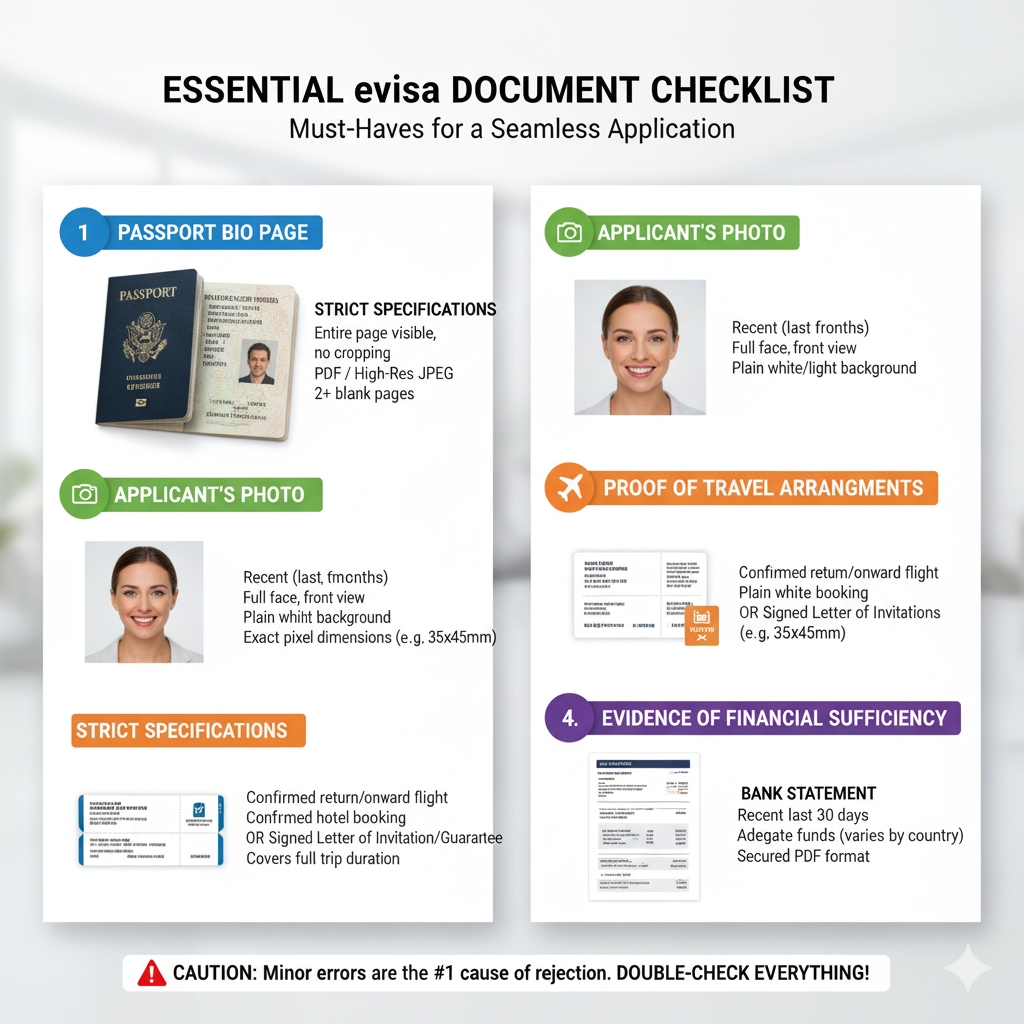
- Passport Bio Page: This must be a clear, color scan of the passport page containing the applicant’s photo and personal details.
- Strict Specification: The entire page must be visible, with no corners cropped. It must be in a PDF or high-resolution JPEG format, and the passport must typically have a minimum of six months validity remaining from the date of entry and possess at least two completely blank pages for stamping.
- Applicant's Photo: A recent, high-quality digital photograph.
- Strict Specification: The photo must be taken within the last six months, showing a full face (front view) against a plain white or light background. Head coverings are generally not permitted unless for religious reasons, and in all cases, the full face must be visible. The file must meet exact pixel dimensions (e.g., 35x45mm digital equivalent).
- Proof of Travel Arrangements (Flight & Accommodation): This is mandatory for almost all tourist and business eVisas.
- Strict Specification: You must provide confirmed, return or onward flight reservations out of the country, along with confirmed hotel bookings or a signed Letter of Invitation/Guarantee from a host for the full duration of your stay.
- Evidence of Financial Sufficiency: This document proves you can support yourself financially during your trip.
- Strict Specification: Often a recent (last 30 days) bank statement showing adequate funds (the required amount varies by country and length of stay, usually equivalent to a few hundred USD). This must be uploaded as a secured PDF.
What is the Difference Between eVisa and Visa on Arrival?
It is crucial to distinguish between the eVisa (secured online and printed beforehand) and the Visa on Arrival (VoA).
- eVisa: Mandatory for certain nationalities, requires pre-application online, and is secured/approved before departure.
- Visa on Arrival (VoA): A sticker visa purchased directly at the port of entry (usually the airport) upon arrival. This option is only available for specific nationalities entering Egypt.
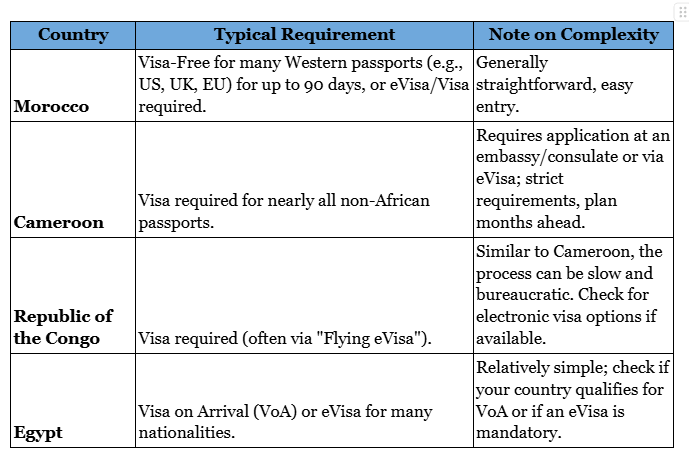
For this multi-country itinerary, only Egypt widely offers the VoA option for many Western and common nationalities (e.g., US, UK, EU, Canada, Australia). Morocco, Cameroon, and the Republic of the Congo strictly require pre-arranged visas (either traditional or eVisa) before boarding your flight.
What is the Egypt Visa on Arrival Process for Eligible Travelers?
If your nationality is eligible for VoA in Egypt, the process is simple and is executed before you reach the immigration desk:

- Locate the Bank Kiosk: Upon arrival at major Egyptian airports (Cairo, Luxor, Hurghada), locate the designated bank kiosks (often marked "Visa for Sale").
- Purchase the Sticker: Pay the required fee (usually in USD or EUR, cash preferred) to purchase a VoA sticker.
- Affix and Proceed: Stick the visa into a blank page of your passport and proceed to the immigration counter for stamping.
Crucial Warning: Always verify your VoA eligibility with the Egyptian consulate before travel. If you are not eligible, you must secure an eVisa or traditional visa beforehand.
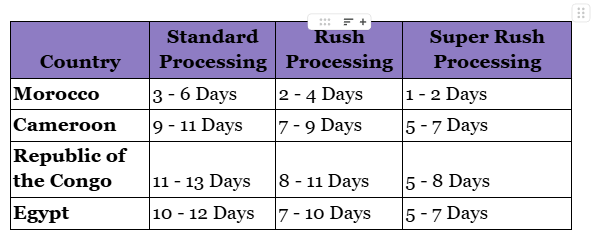
What are Visa Processing Times and Urgency Options?
Processing times are estimates and vary based on the service selected (Standard, Rush, or Super Rush). Always apply well in advance of your trip.
How to Apply for Your African eVisa
The Apply for Morocco eVisa application process is standardized across most African countries utilizing electronic systems, ensuring consistency. Successfully navigating this workflow, particularly the submission and payment phases, is essential for a timely outcome.

Here is the defined process you must follow for all four countries:
- Complete the Form: Carefully fill out the detailed application form. This includes providing precise personal details, passport data, and a full travel itinerary that matches your flight and accommodation proofs.
- Upload Documents: This is the most critical and frequent point of failure. You must upload the required supporting documents (Passport Bio Page, Photo, Flights, etc.), ensuring every file strictly adheres to the mandated file format (PDF, JPEG) and size limits.
- Pay the Fees: The associated Visa Fee and Processing Fee must be paid securely online. Ensure your credit or debit card is enabled for international transactions and take a screenshot of the payment confirmation.
- Await Confirmation & Print: The application enters the processing phase, and you will receive regular status updates via email. The final approved electronic authorization will be sent by email. This document must be printed and kept with your passport for presentation upon arrival at the port of entry.
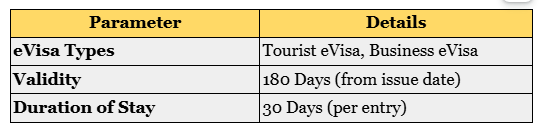
What are the Morocco eVisa Types and Requirements?
Morocco's eVisa system simplifies entry for eligible visitors planning short trips.
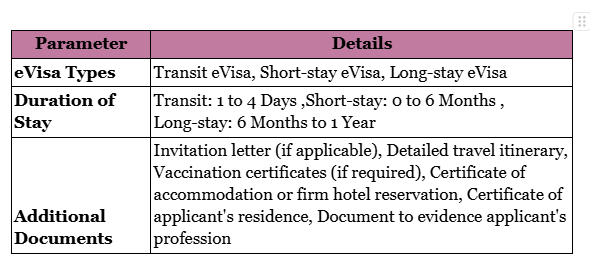
What are the Cameroon eVisa Types and Required Additional Documents?
Cameroon offers distinct eVisa categories tailored to the purpose and length of the visit, reflecting its role as a regional hub.
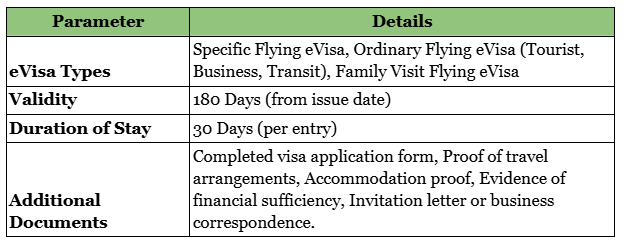
What are the Republic of the Congo eVisa Types and Required Documentation?
The Democratic Republic of the Congo Visa (Brazzaville) utilizes a "Flying eVisa" system, which is categorized by the purpose of the trip.
What are the Egypt eVisa Types and allowed Stay Durations?
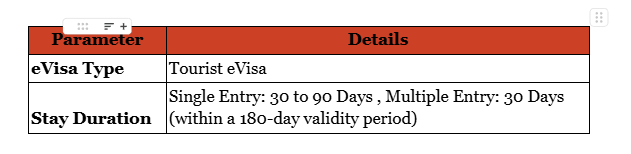
Egypt's eVisa is primarily streamlined for tourism, though options exist for multiple entries.
How Logistically Feasible is a Morocco-Cameroon-Congo-Egypt Trip?
Yes, this itinerary is feasible, but it requires significant air travel, patience, and a flexible mindset. The key challenge lies in the sheer geographical distance and the lack of direct, frequent flight connections between North (Morocco, Egypt) and Central Africa (Cameroon, Congo). This journey will rely heavily on connecting flights, often requiring transit through major hubs like Istanbul (IST), Paris (CDG), or Addis Ababa (ADD).
How Should I Map My Route North, Central, and East Africa?
To minimize backtracking and travel fatigue, a linear flow is recommended:
- North Africa: Start in Morocco (Casablanca or Marrakech).
- Transition to Central Africa: Fly from Morocco (CMN) to Cameroon (DLA or NSI), likely connecting in a West or North African hub.
- Central Africa: Travel between Cameroon and the Republic of the Congo (Brazzaville—BZV) is often done by regional flights or, sometimes, a mix of flights and ground transport/ferries, depending on the precise route and security conditions.
- Eastward Final Leg: Fly from Congo/Cameroon to Egypt (Cairo—CAI), almost certainly via a major international hub.
Budget at least three to four travel days dedicated solely to inter-country transitions and inevitable delays.
What Visa and Documentation Checks Are Needed for Four-Country Clearance?
Visa requirements are the most critical administrative hurdle. They vary significantly by nationality and must be secured before departure. (For full details on eVisa types, processing times, and documents, see the Essential Visa and Entry Requirements section above.)
What are the Essential Vaccinations for Central African Travel?
Health preparation is non-negotiable for the Central African portion of your journey. Consult a travel health specialist 6–8 weeks before your trip.
- Yellow Fever (MANDATORY): A Yellow Fever vaccination certificate (ICV) is legally required for entry into Cameroon and the Republic of the Congo, and often required if traveling from those countries to Egypt, Morocco, or back home.
- Malaria: Both Cameroon and Congo are high-risk malaria zones. Antimalarial prophylaxis (e.g., Malarone, Doxycycline) is strongly recommended.
- Routine Vaccines: Ensure you are up-to-date on Typhoid, Hepatitis A and B, Tetanus, and Rabies (if planning extensive wildlife interaction).
What Are the Must-See Highlights of Morocco Culture, Cuisine, and the Desert?
Morocco offers a stunning introduction to North African culture. It’s the easiest country on this list to navigate, with world-class infrastructure and tourism.
Must-See Highlights: Defining the Essential Itinerary Stops
The following destinations represent the country’s unique blend of cultural immersion, historical significance, and geographical beauty, serving as the essential stops for any first-time visitor.
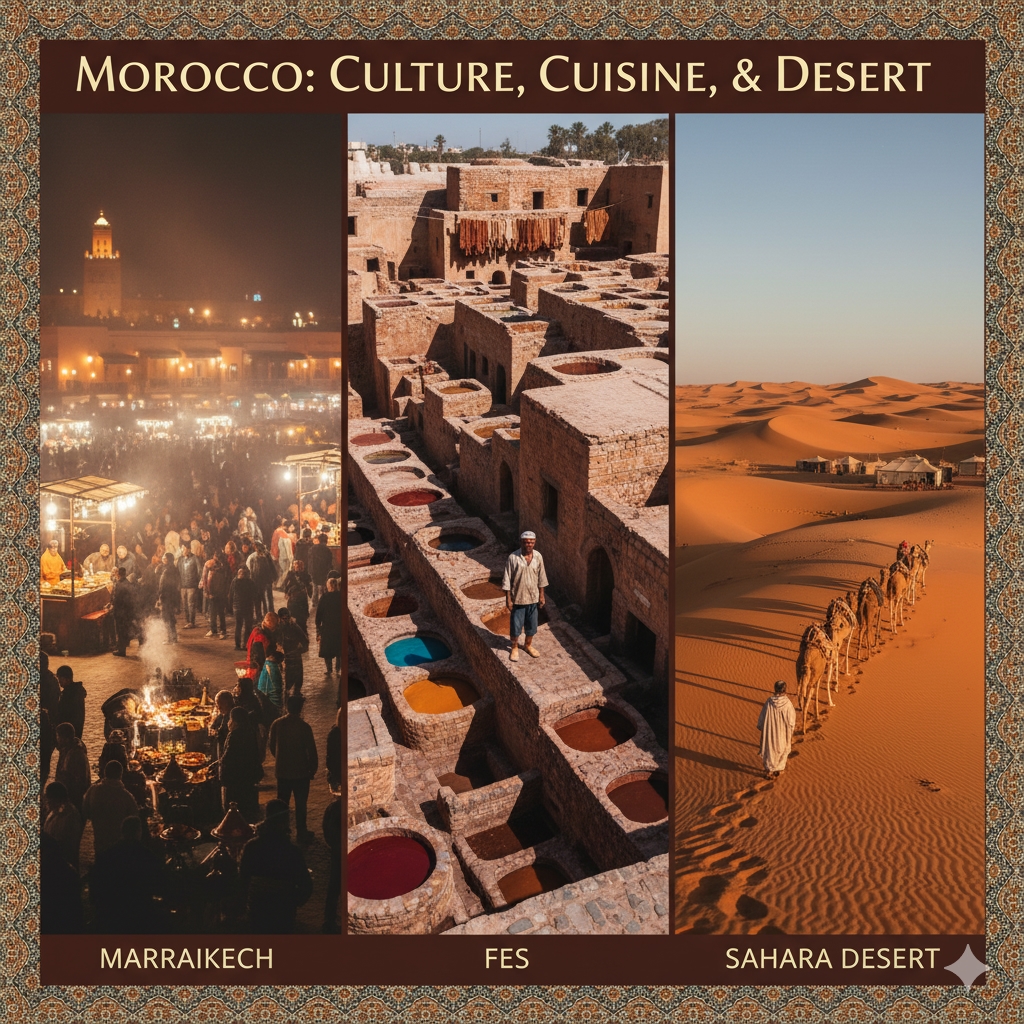
- Marrakech: Dive into the chaos and color of the Medina and experience the nightly spectacle of storytellers and food stalls at Djemaa el-Fna square (a UNESCO). Explore the historical Saadian Tombs and the Bahia Palace.
- Fes: Wander the labyrinthine streets of Fes el-Bali, the oldest walled part of the city. Witness the ancient craft of dyeing leather at the Chouara Tannery and visit the world-renowned Al-Qarawiyyin University.
- Sahara Desert (Erg Chebbi): Take a multi-day journey from Marrakech or Fes to the remote Merzouga region. Experience a peaceful camel trek into the towering golden dunes and spend a memorable night stargazing at a traditional or luxury Berber camp.
- Experience: The scent of spices, the intricate zellij tilework, and the genuine warmth of Berber hospitality.
What Should I Explore in Cameroon, Africa in Miniature?
Cameroon, often called "Africa in Miniature," is a crossroads of West and Central Africa, boasting a diversity of landscapes and cultures unmatched by many of its neighbors.
Must-See Highlights Defining the Essential Itinerary Stops
The Best time to visit Cameroon highlights its extreme ecological and cultural variety, ranging from coastal ports to savanna parks and volcanic peaks.
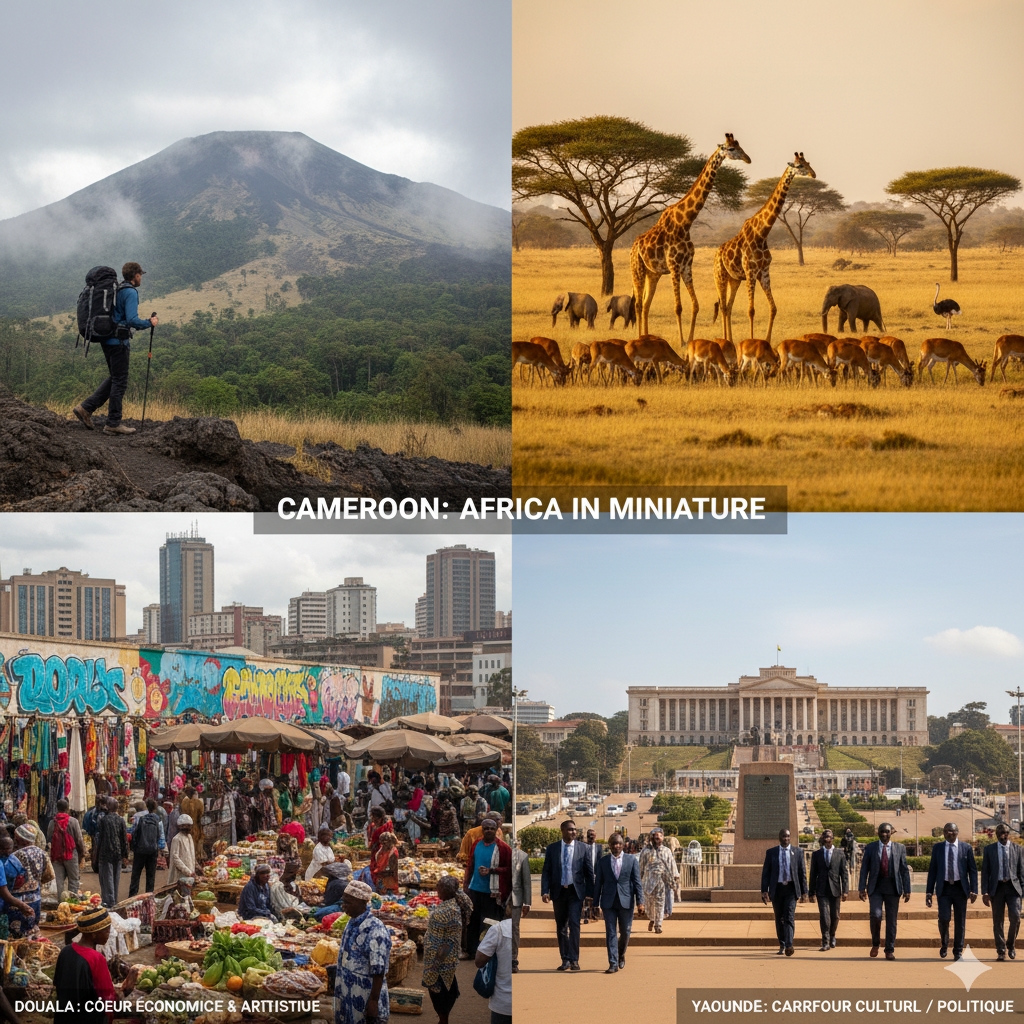
- Mount Cameroon: Hike the highest peak in West Africa and one of the continent's most active volcanoes. This rewarding, multi-day trek takes you through diverse ecological zones, from rainforest to savanna.
- Waza National Park: Located in the north, this is the prime location for traditional savanna wildlife viewing. Look for large herds of kobs, ostriches, giraffes, and occasional elephants, especially during the dry season.
- Douala and Yaoundé: Contrast the two major cities: Douala serves as the economic hub and art capital, while Yaoundé is the administrative capital, offering a glimpse into the country's diverse cultural groups and political history.
- Experience: The vibrant markets, the rich equatorial forest, and the blend of French and English colonial histories.
What Untamed Rainforest Adventures Await in the Republic of the Congo?
The Republic of the Congo (Congo-Brazzaville) offers a deeper dive into the heart of the Congo Basin, providing raw, unadulterated ecological adventure far from the usual tourist trails.
Must-See Highlights: Defining the Essential Itinerary Stops
The itinerary here is focused heavily on pristine natural environments and exceptional, dedicated wildlife conservation efforts.
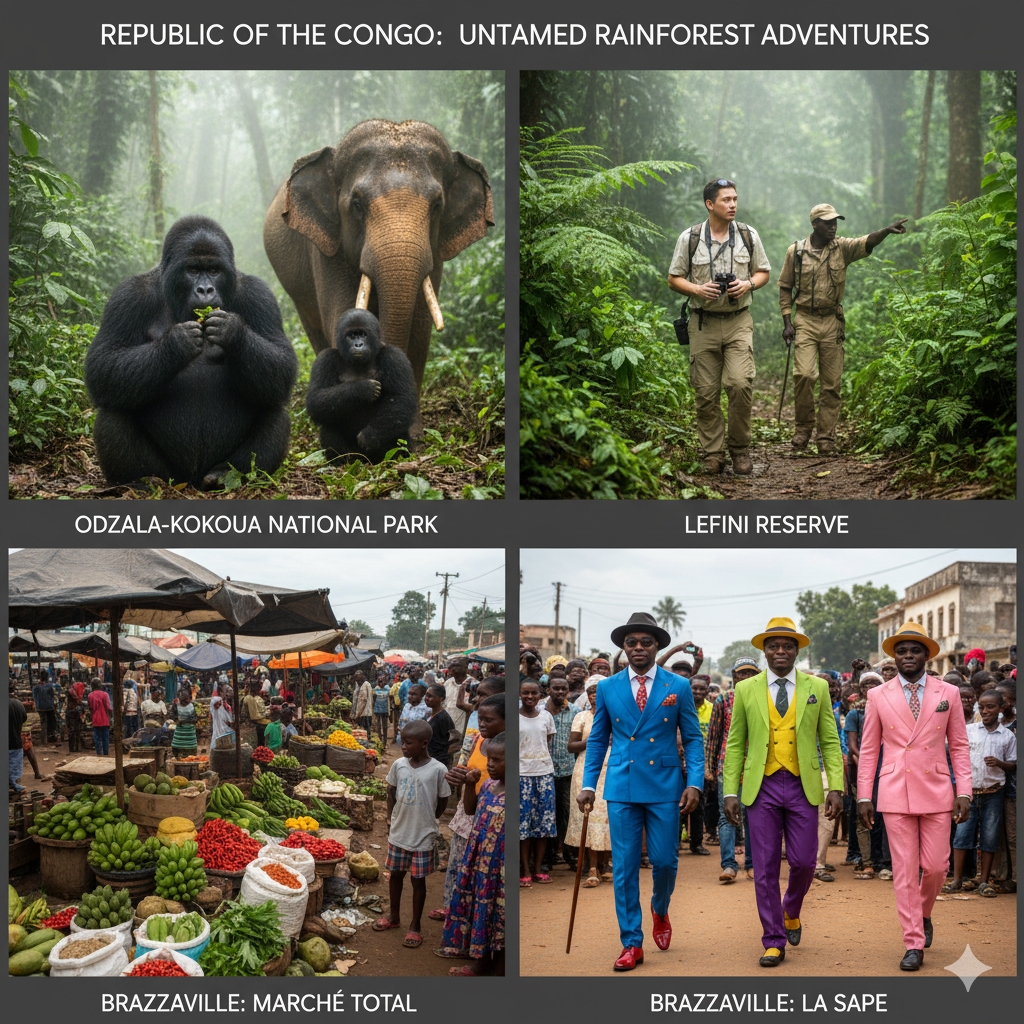
- Odzala-Kokoua National Park: A world-renowned site for ecotourism, known for its habituated western lowland gorillas and forest elephants. Wildlife viewing often takes place in forest bais (clearings) or during guided treks through the dense jungle.
- Brazzaville: Explore the laid-back capital. Key attractions include the vibrant Marché Total (central market), the colonial architecture, and the distinctive culture of the Sapeurs, famous for their extravagant fashion.
- Lefini Reserve: This conservation area is known for its successful work in rehabilitating and protecting primates, particularly western lowland gorillas. It offers a quieter, focused experience on wildlife preservation.
- Experience: The oppressive humidity, the chorus of the jungle, and the privilege of tracking endangered wildlife in its natural habitat.
What Pharaohs, Pyramids, and Nile Experiences Await in Egypt?
Best Places to Visit in Egypt with family is the cultural and historical bookend to your journey, offering a familiar but breathtaking finale. The logistics here are easy compared to Central Africa.
Must-See Highlights: Defining the Essential Itinerary Stops
Egypt's itinerary is centered on the greatest architectural and historical achievements of the ancient world, all linked by the Nile River.
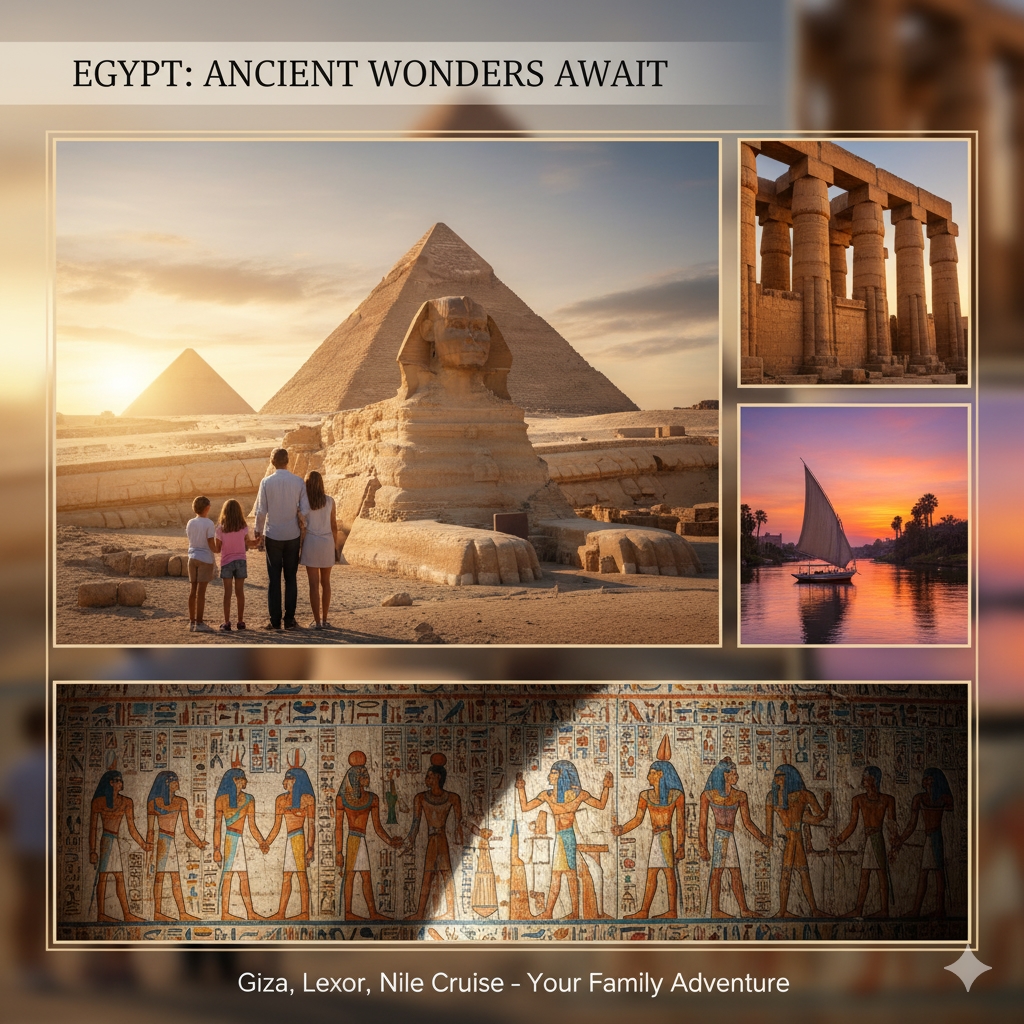
- Giza Plateau: Home to the iconic Great Pyramids of Khufu, Khafre, and Menkaure, along with the enigmatic Great Sphinx. This site represents the pinnacle of ancient Egyptian engineering and power.
- Luxor (Ancient Thebes): This area is a massive open-air museum. Visit the massive temple complexes of Karnak and Luxor Temple on the East Bank, and cross to the West Bank to explore the Valley of the Kings, the burial site of pharaohs.
- The Nile Cruise: Experience the historical lifeline of Egypt by taking a multi-day felucca (traditional sailboat) or luxury cruise between Luxor and Aswan. This offers a peaceful perspective on the riverside life and temples.
- Experience: The sheer scale of ancient history, the organized chaos of Cairo, and the relaxing flow of the mighty Nile.
What Common Mistakes Should I Avoid Visa, Health, and Logistics?
Planning a trip of this scale requires meticulous attention to detail, as errors can quickly derail your itinerary. This section defines the most common pitfalls travelers encounter—covering administrative, health, and logistical failures—and provides clear strategies to avoid them.
Visa and Documentation Blunders
- Assuming VoA for All: Only Egypt offers Visa on Arrival (VoA). For Cameroon and the Republic of the Congo, you MUST have a pre-arranged visa (eVisa or traditional) approved and printed before you even board your flight. Airlines will deny boarding otherwise.
- Passport Photo Errors: Avoid submitting scans of old, physical photos. Use a professional digital passport photo service to ensure the image meets the exact specifications (white background, no shadows, correct dimensions) for eVisa applications.
- Incorrect Visa Type: Do not apply for a Transit visa if you intend to stay for tourism (e.g., in Cameroon). Always apply for the Tourist or Short-Stay visa to ensure adequate validity.
- Missing Blank Pages: Central African countries require full-page stickers and multiple stamps. Your passport must have at least four blank, consecutive pages remaining.
Health and Safety Missteps
- Skipping the Yellow Fever ICV: The International Certificate of Vaccination (ICV) for Yellow Fever is mandatory for entry into Cameroon and the Republic of the Congo. Get the vaccination at least 10 days before your Central African entry and keep the yellow certificate with your passport at all times.
- Underestimating Malaria Risk: Cameroon and Congo are high-risk malaria zones. Take Antimalarial Prophylaxis as prescribed by a travel doctor. Casual prevention (nets/spray) is not enough.
- Tap Water Consumption: Never assume tap water is safe. Rule: Drink only sealed bottled water. This applies to brushing your teeth and avoiding ice cubes, especially in Morocco, Cameroon, Congo, and rural areas of Egypt.
Logistical and Financial Failures
- Expecting Direct Flights: Direct flights between North Africa (Morocco/Egypt) and Central Africa (Cameroon/Congo) are rare. Book connections via major international hubs (e.g., IST, CDG, ADD). Budget an entire day for inter-country travel.
- Relying on Credit Cards: Credit cards are unreliable in Central Africa. Carry a significant reserve of cash (EUR or USD) for Cameroon and Congo, as many local parks, guides, and businesses only accept local CFA Francs (XAF) cash.
- Ignoring Local Transport: Do not try to navigate complex local transport immediately upon arrival in Central Africa. Pre-arrange airport transfers and use reputable, recommended local drivers until you are oriented.
How Much Does Entry Documentation Cost Visa and Health Permits?
The administrative costs associated with this multi-country journey must be defined clearly, as they represent a significant fixed expense for visa-required travelers. The final cost for any visa is highly dependent on the applicant's nationality and the current exchange rates.
- Central African Visas (Cameroon/Congo): These are typically the most complex and can be the most costly. The final fee often combines a base visa charge and a consular service fee. The total expense depends on whether you select a single or multiple entry, and whether expedited processing is necessary.
- Egyptian Visa (VoA/eVisa): The total Egyptian e-visa fee is comprised of two main parts:
- Visa Fee: This is the basic charge for the eVisa itself, which is nationality-dependent.
- Processing Fee: This fee varies based on the urgency or processing type (Standard or Urgent) chosen during the online application.
- Moroccan Visa: For nationalities requiring a visa, the cost involves an application fee set by the consulate, which is subject to reciprocity agreements between Morocco and the traveler's home country.
- Yellow Fever Certificate (MANDATORY): This is a mandatory health document for entry into Central African nations like Cameroon and Congo, and it is a separate administrative cost. The cost is determined by your home country's healthcare provider or travel clinic.
What Is the Best Time to Visit When Aligning Four Climates?
Aligning the optimal weather for all four countries is impossible. The priority should be avoiding the heavy rainy season in Cameroon and Congo.
- Best Window: November to February. This covers the dry, cooler season in North and East Africa and minimizes the heaviest rainfall in the Congo Basin, making ground travel easier and improving wildlife viewing.
- Morocco/Egypt: Pleasant, slightly cooler temperatures.
- Cameroon/Congo: Reduced rainfall, though humidity remains high.
What Are the Expert Safety and Security Tips for This Multi-Regional Journey?
While all these countries welcome tourists, Central Africa requires heightened awareness.
- Political Stability: Always check government travel advisories (e.g., US State Dept., UK FCDO) for specific regions in Cameroon (especially the Anglophone regions) before booking.
- Scams and Theft: This is most common in crowded tourist areas like the Marrakech Medina or Cairo’s streets. Practice discreet carry of valuables.
- Local Transport: Avoid traveling by road at night, particularly outside major cities in Cameroon and Congo. Domestic air travel is often the safer, faster option.
- Photography: Be cautious when taking photos, especially near government buildings, police, or military checkpoints in Cameroon and Congo. Always ask permission before photographing individuals.
How Can I Manage Currency and Communication Across the Continent?
Navigating local currencies and ensuring seamless communication are essential for managing the sheer scale of this trip. Given the diversity across North, Central, and East Africa, you’ll encounter varied financial and linguistic environments.
Currency Management: Cash vs. Cards
- Cash is King in Central Africa: In Cameroon and the Republic of the Congo, transactions are overwhelmingly cash-based (EUR or USD) for Cameroon and Congo, as many local parks, guides, and businesses only accept local CFA Francs (XAF) cash.
- Mixed Economy in North Africa: In Morocco and Egypt, ATMs are reliable in major cities and tourist areas. Credit cards are accepted in high-end hotels and restaurants, but you will need cash for small shops, tips, and street vendors.
- Exchange Tip: EUR and USD are the best foreign currencies to carry for exchange across all four countries. Do your major currency exchanges at the airport or established banks.
Communication: Language and Connectivity
- Reliability Varies: Connectivity is generally fast and reliable in Morocco and Egypt, especially in city centers and hotels.
- The Central African Challenge: In Cameroon and Congo, Wi-Fi is intermittent and often limited to major hotels. Expect slower speeds and potential power-related outages. Don't rely on being constantly connected.
- Local SIM Cards (Highly Recommended): Purchasing a local SIM card upon arrival in each country (e.g., Maroc Telecom, Orange, Vodafone Egypt, MTN/Airtel in Central Africa) is the most efficient and cost-effective way to ensure you have consistent mobile data for navigation and essential communication. This also bypasses expensive international roaming fees.
This monumental journey offers the dedicated traveler a genuine snapshot of Africa's boundless variety. While the logistics are challenging, the reward is an unparalleled perspective on history, nature, and human resilience. Start planning your visas and saving for those flights the continent awaits
Written By:
Noah Williams

Hotels at your convenience
Now choose your stay according to your preference. From finding a place for your dream destination or a mere weekend getaway to business accommodations or brief stay, we have got you covered. Explore hotels as per your mood.