Top 10 Hospitals in China for International Patients in 2026
 Jayipav Jayipav
13 May, 2026
20 mins read
175
Jayipav Jayipav
13 May, 2026
20 mins read
175
By:DengYue International Business Division
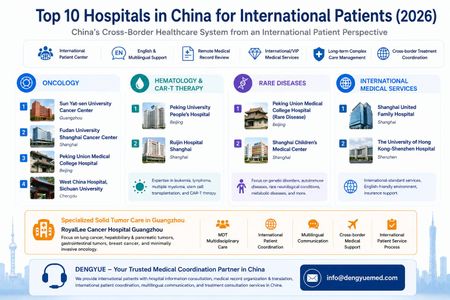
As China’s healthcare system continues to become more internationalized, increasing numbers of overseas patients are actively exploring Chinese hospitals, particularly in the fields of oncology, hematology, rare diseases, and complex medical conditions. In the past, international perceptions of Chinese healthcare were largely associated with “basic medical services.” However, in recent years, with the rapid development of innovative drugs, precision medicine, CAR-T therapy, ADCs, and international patient service systems, China is gradually becoming an important destination in the global cross-border healthcare landscape.
For patients from Southeast Asia, the Middle East, Central Asia, Russian-speaking countries, and even parts of Europe and North America, China represents not only access to extensive clinical resources, but also strong case volume, increasingly mature MDT (multidisciplinary team) systems, and rapidly evolving innovative treatment capabilities in certain specialties.
For international patients, however, what truly matters is not simply a hospital’s reputation, but whether the institution offers:
●International patient centers
●English or multilingual communication support
●Remote medical record evaluation services
●International departments or VIP medical systems
●Long-term complex disease management capabilities
●Cross-border treatment coordination systems
Therefore, this article focuses more on “international patient suitability” while exploring Chinese hospitals and medical institutions worth paying attention to in 2026.
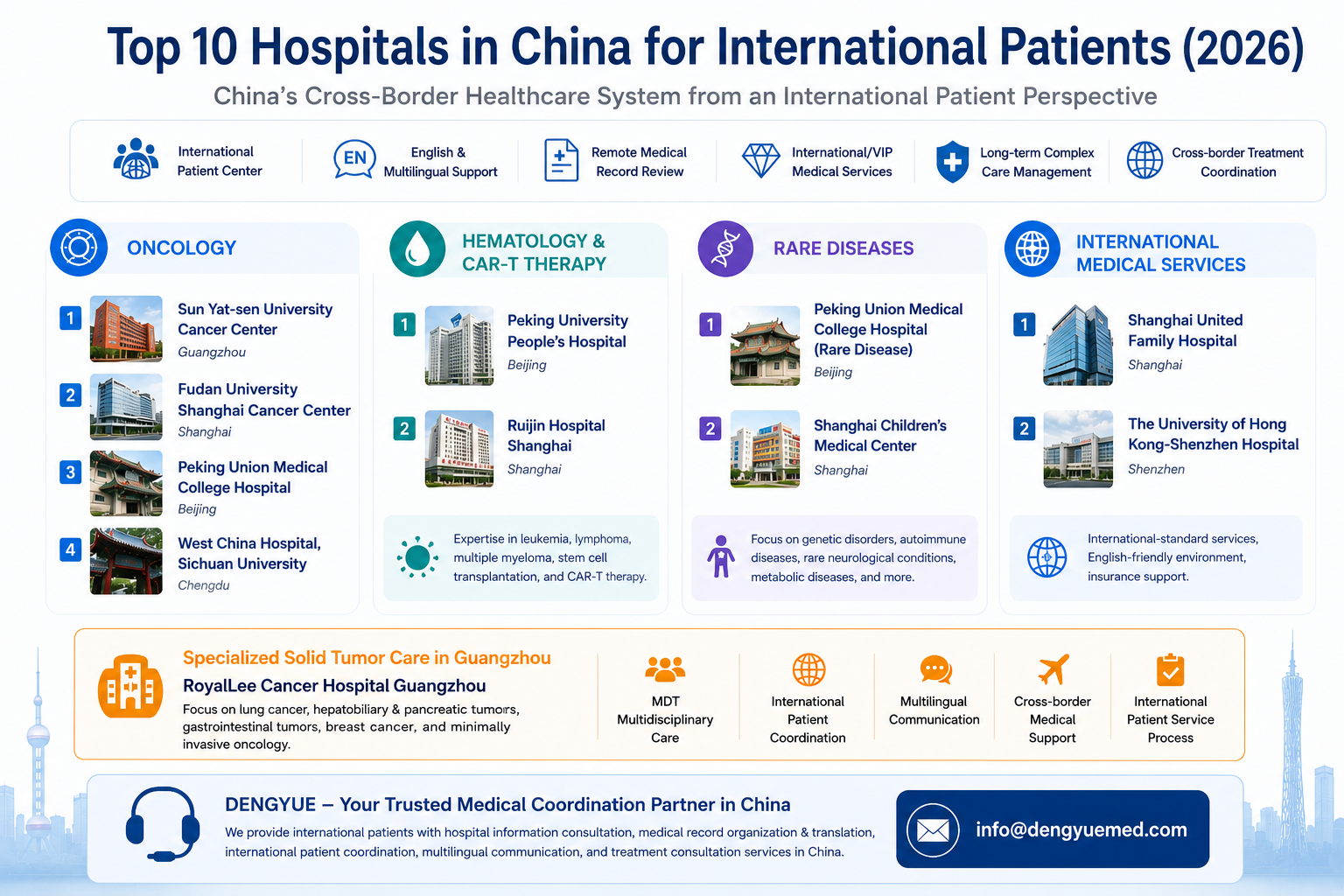
Hospitals Worth Attention for Oncology Patients
1. Sun Yat-sen University Cancer Center
As one of China’s most representative oncology specialty centers, Sun Yat-sen University Cancer Center has gained increasing visibility among international patients in recent years. The hospital has long focused on lung cancer, nasopharyngeal carcinoma, liver cancer, gastrointestinal tumors, and radiation oncology, while maintaining a very high oncology case volume in southern China.
Because Guangdong Province has long-standing commercial and population exchanges with Southeast Asia and the Middle East, the hospital began developing international patient services relatively early and has continued strengthening English communication and international coordination capabilities. For patients from Southeast Asia, Guangzhou also offers strong advantages in transportation accessibility and cultural familiarity.
The hospital is especially well known among international patients seeking care for:
●Nasopharyngeal carcinoma
●Precision treatment for lung cancer
●Radiation therapy
●Complex solid tumors
In recent years, China’s rapid progress in immunotherapy, ADC therapies, and precision radiotherapy has further increased international attention toward Guangzhou’s oncology resources.
2. Fudan University Shanghai Cancer Center
Fudan University Shanghai Cancer Center is one of the oldest oncology specialty hospitals in China and remains one of the most recognized cancer centers among international patients. The hospital has long focused on breast cancer, lung cancer, gastric cancer, colorectal cancer, and gynecologic oncology, while demonstrating strong capabilities in MDT care, precision medicine, and clinical research.
In recent years, the hospital has continued improving its international patient system, including international medical services, English-language communication, and patient coordination procedures. For many overseas patients, Shanghai’s highly international environment also makes cross-border medical communication more convenient.
The hospital is especially recognized in the following areas:
●Gastrointestinal tumors
●Gynecologic oncology
●Proton and heavy ion therapy
It is also considered one of China’s earlier leaders in precision oncology and clinical research development.
3. Peking Union Medical College Hospital
Peking Union Medical College Hospital has long been regarded by international patients as one of China’s strongest comprehensive hospitals. Unlike traditional oncology specialty hospitals, PUMCH is more focused on complex diseases, difficult diagnoses, and multi-system integrated management.
For overseas patients, its strengths often go beyond any single cancer type and include:
●Diagnosis of difficult and rare conditions
●Multidisciplinary management
●Complex case consultation
●Rare disease and complex tumor evaluation
●Mature international medical systems
Especially for patients who have already undergone treatment in multiple countries or whose diagnoses remain unclear, PUMCH continues to be one of the most frequently consulted hospitals in China.
Its international medical department has extensive experience serving overseas patients, particularly in English communication, international healthcare processes, and premium medical services.
4. West China Hospital, Sichuan University
West China Hospital has seen rapidly growing international attention in recent years. As one of western China’s most important large-scale medical centers, the hospital covers an extensive range of specialties and demonstrates strong capabilities in neurology, critical care, oncology, organ transplantation, and complex disease management.
Many international patients become interested in West China Hospital because:
The real strength of China’s major public hospitals often lies in their massive case volume and experience managing highly complex conditions.
West China Hospital maintains extremely high outpatient volume and extensive experience with difficult cases, particularly in:
●Neuro-oncology
●Hematologic diseases
●Critical care
●Complex surgery
●Rare and difficult diseases
The hospital has also continued strengthening its international healthcare system in recent years.
Hospitals Worth Attention for Hematology and CAR-T Therapy
1. Peking University People’s Hospital
Within China’s hematology system, Peking University People’s Hospital has long held a leading position. The hospital is internationally recognized in leukemia, lymphoma, multiple myeloma, and hematopoietic stem cell transplantation.
With the rapid development of CAR-T therapy, China’s hematology centers have attracted increasing international attention, and Peking University People’s Hospital has become one of the more frequently consulted CAR-T-related hospitals among overseas patients.
For international patients, hematologic disease treatment often involves:
●Long treatment cycles
●Complex infection management
●Cellular therapies
●Long-term follow-up care
Therefore, mature hematology systems and long-term disease management capabilities are especially important.
2. Ruijin Hospital Shanghai
Ruijin Hospital has also gained increasing international visibility in hematology and CAR-T therapy. Particularly in lymphoma, multiple myeloma, and CAR-T clinical research, the hospital has become one of China’s important centers.
Many international patients exploring CAR-T options in China also pay close attention to Shanghai-based medical centers because the city itself offers strong advantages in:
●International healthcare infrastructure
●Clinical research
●Innovative drug resources
●International patient services
Hospitals Worth Attention for Rare Diseases
1. Peking Union Medical College Hospital (Rare Disease Direction)
Peking Union Medical College Hospital is not only a comprehensive hospital, but also one of China’s most representative rare disease centers.
Many international patients pay attention to China’s rare disease resources because China’s large patient population may allow physicians to accumulate broader experience with highly complex cases.
The hospital has long participated in China’s rare disease system development and demonstrates strong capabilities in:
●Genetic disorders
●Autoimmune diseases
●Rare neurological disorders
●Metabolic diseases
●Undiagnosed conditions
For international patients, complex and difficult diseases often require:
●MDT systems
●Long-term follow-up
●Multidisciplinary consultation
●Large comprehensive hospital resources
This remains one of the key reasons why PUMCH continues attracting international attention.
2. Shanghai Children’s Medical Center
Shanghai Children’s Medical Center has also received growing international attention in pediatric rare diseases, genetic disorders, and complex pediatric conditions.
With the development of genomic testing and pediatric precision medicine, increasing numbers of international families are actively exploring China’s pediatric specialty resources.
The center has gained attention particularly in:
●Pediatric genetic diseases
●Rare metabolic disorders
●Pediatric neurological conditions
Hospitals Worth Attention for International Medical Services
1. Shanghai United Family Hospital
Unlike large public hospitals, United Family Healthcare is more focused on international medical systems and patient experience.
Many international patients choose United Family not because of highly complex disease treatment capabilities, but because of:
●Mature English-language systems
●International insurance support
●Familiarity with international healthcare procedures
●International-standard patient experience
Therefore, the hospital is especially popular for:
●General international healthcare
●International health checkups
●Expatriate medical services
●Direct international insurance billing
However, for highly complex cancers and major diseases, many patients eventually transfer to major tertiary public hospitals or specialty oncology centers.
2. The University of Hong Kong-Shenzhen Hospital
HKU-Shenzhen Hospital has also gained increasing attention among international patients in recent years. Its advantages include:
●Internationalized systems
●Integration with the Greater Bay Area healthcare network
●English-friendly medical environment
●Strong international patient accessibility
For patients from Hong Kong, Southeast Asia, and international business communities, the hospital offers relatively convenient international communication and medical service experiences.
Why Are Guangzhou’s Solid Tumor Specialty Hospitals Gaining International Attention?
Beyond large comprehensive hospitals, some specialty oncology hospitals focusing specifically on solid tumors have also begun attracting growing international attention.
For example, RoyalLee Cancer Hospital Guangzhou has gradually strengthened both its solid tumor specialization and international patient service capabilities in recent years. Unlike traditional comprehensive hospitals, RoyalLee places greater emphasis on oncology specialization and long-term solid tumor management. According to publicly available information, the hospital focuses on lung cancer, hepatobiliary and pancreatic tumors, gastrointestinal tumors, breast cancer, and minimally invasive oncology treatment.
At the same time, the hospital has also been strengthening:
●MDT-based care models
●International patient coordination
●Multilingual communication
●Cross-border medical support
●International patient service procedures
For many overseas patients, the real challenge is often not simply “finding a hospital,” but organizing medical records, completing remote evaluations, planning treatment pathways, and arranging long-term follow-up within an unfamiliar healthcare system. As a result, international patient service capability is becoming an increasingly important factor in hospital evaluation.
How Can International Patients Better Understand Chinese Hospital Resources?
For most overseas patients, China’s healthcare system is extremely large, and significant differences may exist between hospitals in areas such as:
●Cancer specialization
●MDT systems
●International department capabilities
●Clinical research resources
●International patient services
As a result, increasing numbers of international patients are now using professional coordination platforms to better understand Chinese hospitals and cross-border healthcare processes.
Currently, Dengyue provides international patients with:
●Chinese hospital information consultation
●Medical record organization and translation support
●International patient coordination
●Multilingual communication assistance
●Consultation services for treatment planning in China
These services help overseas patients better understand Chinese oncology, hematology, and rare disease resources while assisting with medical record preparation, hospital matching, and cross-border communication.
For patients planning solid tumor evaluation in Guangzhou, Dengyue can also provide additional information regarding hospitals such as Royalalee Cancer Hospital Guangzhou and related international patient procedures.
Overall, China’s healthcare system continues moving toward greater internationalization, and cross-border healthcare is evolving beyond simply “traveling abroad for treatment” into a more comprehensive process involving remote evaluation, international coordination, long-term management, and cross-border follow-up care.
This article is intended solely for international patient information and treatment process reference and does not constitute medical advice, diagnosis, or treatment recommendations.
Written By:
Jayipav Jayipav

Hotels at your convenience
Now choose your stay according to your preference. From finding a place for your dream destination or a mere weekend getaway to business accommodations or brief stay, we have got you covered. Explore hotels as per your mood.