Uzbekistan: A Journey Through Time on the Silk Road
 Lisa Beck
15 Aug, 2025
11 mins read
96
Lisa Beck
15 Aug, 2025
11 mins read
96
In the heart of Central Asia lies a land steeped in history, a vibrant crossroads where empires rose and fell, and cultures converged to create a legacy of unparalleled beauty. Uzbekistan, often hailed as the "jewel of Central Asia," is a living museum, its cities whispering tales of legendary conquerors, brilliant scholars, and the bustling caravans of the Great Silk Road. This article invites you on a profound journey through the nation's historic side, exploring the architectural wonders, the rich cultural tapestry, and the enduring spirit that makes Uzbekistan a must-visit destination.
The Golden Age of the Silk Road: A Legacy of Splendor
The history of Uzbekistan is inextricably linked to the Silk Road, the ancient network of trade routes that connected the East and West for over a millennium. For centuries, cities like Samarkand, Bukhara, and Khiva flourished as key hubs, becoming centers of commerce, art, and intellectual thought. This era, particularly during the reign of the Timurid dynasty in the 14th and 15th centuries, is often referred to as the "Timurid Renaissance." It was a time of extraordinary architectural innovation, scientific discovery, and artistic expression, a legacy that is vividly preserved in the nation’s monumental structures.
The very essence of this golden age is captured in the magnificent city of Samarkand, a UNESCO World Heritage Site. At its heart lies Registan Square, a public plaza that has been the soul of the city for centuries. Its name, meaning "sandy place" in Persian, alludes to its origins as a bustling marketplace. Today, it is an awe-inspiring ensemble of three grand madrasahs (Islamic schools): the Ulugbek, Sher-Dor, and Tilya-Kori. The Ulugbek Madrasah, built in the 15th century, was a prestigious center of learning, where subjects like astronomy and mathematics were taught. Its founder, the scholar-king Ulugbek, was a grandson of the legendary conqueror Amir Timur (also known as Tamerlane). The Sher-Dor Madrasah, built in the 17th century, is famous for its intricate tile work depicting lions with sun faces, a highly unusual motif in Islamic art. Completing the trio is the Tilya-Kori Madrasah, which features a breathtaking interior known for its stunning gold-leaf decoration, earning it the name "Gold-Covered." The sheer scale and intricate artistry of Registan Square make it one of the most magnificent public squares in the world, a testament to the architectural genius of the Timurid era.
Not far from the square stands the monumental Bibi-Khanym Mosque, one of the most important monuments of Samarkand. Commissioned by Amir Timur himself after a successful campaign in India, it was intended to be the grandest mosque in the Islamic world. The mosque's construction, which began in the late 14th century, reportedly involved a workforce of artisans and architects from across Timur's vast empire, even utilizing elephants brought back from India to carry building materials. Although the building suffered from structural issues and was later damaged by an earthquake, its scale and decorative elements, including its elaborate tile work and massive portal, still exude a majestic presence that overwhelms visitors. It serves as a powerful symbol of Timur’s ambition and his desire to leave a lasting legacy.
Khiva: A Living Museum
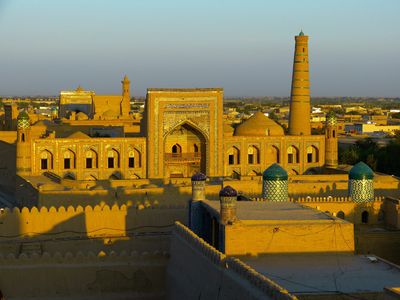
While Samarkand captivates with its grandeur, the ancient city of Khiva offers a different kind of magic. This UNESCO-protected city is a remarkably well-preserved example of an ancient Silk Road oasis. At its core is Ichan Kala, the inner walled city, which feels like a journey back in time. Walking through its narrow, winding streets, you are surrounded by a symphony of exquisite blue and green tiled facades, towering minarets, and historic mosques.
Among the city’s most distinctive landmarks is the Kalta Minor Minaret. Its name, meaning "short minaret," is a clue to its history. The minaret was commissioned in the mid-19th century by Muhammad Amin Khan with the intention of making it the tallest in Central Asia. However, construction was halted after the khan's untimely death, leaving the minaret at its current height of 29 meters. Its most unique feature is its complete coverage in vibrant glazed tiles and majolica, making it a spectacular and iconic symbol of Khiva's architectural heritage. Exploring Khiva's Ichan Kala is an experience of immersion, a chance to feel the pulse of a city that has defied time and preserved its unique character.
Tashkent: The Modern Capital with Ancient Roots
Uzbekistan’s capital, Tashkent, presents a fascinating blend of the old and the new. While it is a modern, bustling metropolis, its history is deeply ingrained in its architecture and cultural institutions. A shining example of this is the Amir Timur Museum, a significant landmark in the city. Opened in 1996 to commemorate the 660th anniversary of Amir Timur's birth, the museum is dedicated to the history of the Timurid dynasty. The three-story building, with its classic oriental dome, is a treasure trove of artifacts, including ancient manuscripts, weapons, clothing, and various exhibits that shed light on the scientific and cultural achievements of the Timurid era. The museum’s centerpiece is a massive crystal chandelier that hangs from the dome, symbolizing the light of the Timurid Renaissance. It is a powerful reminder of Uzbekistan's rich past and its enduring connection to the legacy of one of history's greatest conquerors.
In addition to its Islamic heritage, Tashkent also holds a fascinating blend of cultures. The Alexander Nevsky Cathedral stands as a testament to the city's more recent history under Russian rule. Built in the early 20th century, this Orthodox cathedral, situated in the Botkin Cemetery territory, is the oldest surviving Orthodox church in Tashkent. Its distinctive architecture and richly decorated interior, with its beautiful frescoes and gilded iconostasis, offer a glimpse into the city's multi-ethnic past.
Another cultural jewel is the Navoi Theater, officially known as the Alisher Navoi State Academic Bolshoi Theater. Named after the great poet and statesman Alisher Navoi, it is the national opera and ballet theater of Uzbekistan. The theater's history is particularly poignant, as its construction was completed in the 1940s by Japanese prisoners of war, who contributed their exceptional skills and artistry to the building's intricate facade and grand interior. Today, it stands not only as a hub for the performing arts but also as a symbol of resilience, creativity, and the power of collaboration.
Beyond the Cities: A Mosaic of History
Uzbekistan's historical wealth extends far beyond its major cities. The birthplace of Amir Timur, Shahrisabz, is home to the remains of his majestic Ak-Saray Palace and a complex of tombs and religious sites. The city of Bukhara, another ancient Silk Road hub, is a masterpiece of medieval Islamic architecture with its narrow alleys, ancient madrasahs, and the imposing Ark Fortress. These sites, along with countless others, form a tapestry of history that tells the story of a nation at the crossroads of civilization.
Conclusion: An Inspirational Journey Awaits
Uzbekistan is more than a destination; it is an experience that awakens the senses and inspires the soul. The captivating beauty of Registan Square, the timeless charm of Khiva’s minarets, and the vibrant life of Tashkent's historic landmarks invite you to step out of the ordinary and into a world of wonders. The intricate tilework, the echoing calls to prayer, and the warm hospitality of its people are a constant reminder of a glorious past that continues to shape the present. For those seeking to delve into history, culture, and pure inspiration, Uzbekistan, the jewel of Central Asia, awaits. It is a journey that promises not just to show you history, but to make you a part of it.
Written By:
Lisa Beck

Hotels at your convenience
Now choose your stay according to your preference. From finding a place for your dream destination or a mere weekend getaway to business accommodations or brief stay, we have got you covered. Explore hotels as per your mood.