Why Kedarkantha is the Undisputed Queen of Winter Treks
 Roopkund Heaven
12 Mar, 2026
18 mins read
82
Roopkund Heaven
12 Mar, 2026
18 mins read
82
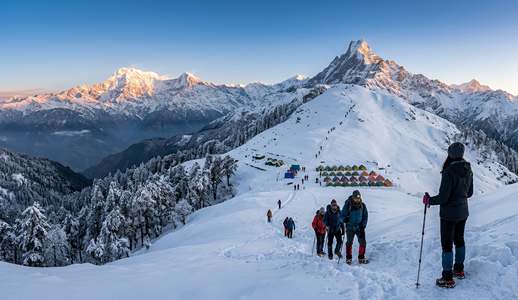
Imagine standing at a snowy trailhead at 4:00 AM, the temperature has dipped to $-8$°C, and your breath forms thick clouds in the glow of your headlamp. You look up, and the Milky Way is so vivid it feels like you could reach out and touch it. As you take your first step onto the crunchy, frozen crust of the trail, the only question in your mind is: "Can I actually make it to the top?" This is the moment of truth that thousands of adventurers face every winter. If you are searching for that perfect balance of a high-altitude adrenaline rush and a scenic wonderland, you have likely realized that Why Kedarkantha is the Undisputed Queen of Winter Treks is the most discussed topic in the Indian trekking community today.
In this ultimate guide, we are going to dive deep into the logistics, the emotional highs, and the gritty realities of this trail. We will cover everything from the legendary campsites of Juda Ka Talab to the technicalities of the summit push at 12,500 ft. Whether you are a first-timer worried about the cold or a seasoned trekker looking to understand the hype, this blog serves as your definitive roadmap to the most iconic winter experience in the Himalayas.
🏔️ 1. The Geographic Brilliance: Why Kedarkantha Stands Alone
To understand Why Kedarkantha is the Undisputed Queen of Winter Treks, we must first look at its unique topography. Most Himalayan treks are either "valley walks" or "pass crossings." A valley walk, like Har Ki Dun, keeps you deep in the troughs of the mountains, while a pass crossing, like Bali Pass, is often too technical for winter. Kedarkantha is a "Summit Trek." This means you aren't just crossing through the mountains; you are standing on a localized peak that offers a 360-degree unobstructed view of the Greater Himalayas.
Located in the Govind Wildlife Sanctuary of Uttarkashi, the trek starts from the hub of Sankri. While most high-altitude trails become inaccessible after the first heavy snowfall in December, Kedarkantha remains perfectly "trek-able." The gradient is a classic bell curve—gradual at the start, slightly steeper in the middle, and a thrilling final scramble to the summit. This makes it geographically accessible to a wide demographic, from ten-year-olds to sixty-year-olds, provided they have basic fitness.
The Phenomenon of Early Snow
Unlike many trails in the Kumaon or Himachal regions that might stay dry until late January, the Kedarkantha region sits in a "snow-trap" zone. The moisture-laden winds from the West hit these ridges first, often resulting in knee-deep snow as early as the second week of December. For a trekker, this is the ultimate draw. You don't just see snow on the distant peaks; you live in it from the moment you leave the base camp. This early and consistent snowfall is the primary reason why it earns its "Queen" title.
The Connectivity of the Trail
The trail design is a masterclass in Himalayan aesthetics. You aren't just walking on a monotonous path. Every two kilometers, the landscape shifts. You move from dense, dark pine forests that block out the sun to wide-open clearings where the sun reflects off the snow with blinding intensity. This variety prevents "trail fatigue," a common psychological hurdle where trekkers lose motivation because the scenery doesn't change. In Kedarkantha, the "wow" moments are spaced perfectly to keep your dopamine levels high.
🌲 2. The Enchanted Forest and the Legend of Juda Ka Talab
The first section of the trek is often underestimated by beginners. You gain nearly $2,500$ ft of altitude on the first day alone. But what makes this part of the journey magical is the transition into the forest. These aren't just any trees; these are ancient Pine, Oak, and Maple forests that have stood for centuries. In winter, the pine needles are draped in "frost-fingers," and the silence is so profound you can hear a bird's wings flap from fifty yards away.
The Mystery and Beauty of Juda Ka Talab
Juda Ka Talab, sitting at $9,100$ ft, is arguably the most famous campsite in India. Legend has it that Lord Shiva once sat here and opened a small lock of his hair (Juda), and the water that flowed out formed this lake (Talab). In the peak of winter, the lake freezes completely. You can see bubbles trapped beneath an inch-thick layer of ice, creating a glass-like surface that reflects the surrounding trees.
For a trekker, camping here is a lesson in survival and wonder. This is usually where you experience your first "Himalayan Night." As the sun sets, the temperature drops rapidly. You learn the importance of the right backpack for trekking and why having your thermal layers easily accessible is a life-saver. Juda Ka Talab acts as the emotional hook of the trek—once you spend a night here under the stars, you are officially in love with the mountains.
Forest Navigation and Terrain Difficulty
The terrain here is "Moderate." It is a steady zig-zag climb. Beginners often struggle with their breathing rhythm here. The key is the "Himalayan Shuffle"—taking small, consistent steps rather than large, lunging strides. The forest floor can be slippery due to "black ice" (a thin, transparent layer of ice on rocks). This is where your trekking poles become your best friends. They provide the four-point stability needed to navigate the uneven forest floor without twisting an ankle.
⛺ 3. The Base Camp Experience: Living on the Edge of the World
If Juda Ka Talab is the "Heart," the Kedarkantha Base Camp at $11,250$ ft is the "Spirit." Leaving the forest behind, you emerge onto a massive open slope. Ahead of you, the Kedarkantha summit looms like a white pyramid. Behind you, the entire Swargarohini range, Bandarpoonch, and Black Peak reveal themselves in a jagged, icy line.
The Psychological Shift at Base Camp
This is where the trek gets serious. At $11,250$ ft, the air is noticeably thinner. For many beginners, this is the highest they have ever stood. The psychological impact of being surrounded by nothing but snow and sky is immense. You aren't just a tourist anymore; you are a trekker. The camaraderie at base camp is legendary. Since everyone is preparing for the $2:00$ or $3:00$ AM summit push, there is a shared sense of nervous excitement.
Weather Behavior and Survival
At base camp, the weather is the boss. You might have a clear blue sky at 3:00 PM, and by 5:00 PM, a "whiteout" could blow in, reducing visibility to five feet. This is why hiring a local travel company matters. Local guides can "smell" a storm coming and will know exactly when to hunker down or when to push for the summit. Survival here is about "Layering." You need a base layer to wick sweat, a mid-layer for warmth, and a heavy down jacket to trap heat. If you get wet at base camp, you are in trouble—moisture is the enemy of warmth.
Expertise: Managing Oxygen and Hydration
A common mistake at base camp is "laziness." Trekkers get cold, crawl into their sleeping bags, and stop drinking water. This is a fast track to Acute Mountain Sickness (AMS). You must follow the AMS rules for your first high altitude trek. This means drinking at least 4 liters of water a day, even if you aren't thirsty, and staying active around the campsite to help your lungs adjust to the lower oxygen levels.
🏆 4. The Summit Push: A Test of Grit and Glory
The final ascent to the Kedarkantha summit ($12,500$ ft) is why this trek is called the "Queen." Most groups start their climb between 2:00 AM and 4:00 AM. Why? Because you want to be at the top when the sun breaks over the horizon, and because the snow is hardest and easiest to walk on before the sun softens it.
The Technicality of the Scramble
The final 1,000 feet are the steepest. This isn't technical mountaineering, but it requires "Micro-spikes" or "Crampons" attached to your boots. These metal teeth grip the ice, allowing you to walk up 45-degree slopes with confidence. For a beginner, the sight of a vertical white wall in the dark can be intimidating. This is where your mental strength is tested. You focus on the heels of the person in front of you. You breathe in a rhythm—step, breathe, step, breathe.
The $360$-Degree Reward
Reaching the summit is a spiritual experience. At the top sits a small shrine dedicated to Lord Shiva. As the sun rises, the peaks of Gangotri, Yamunotri, and the Har Ki Dun valley turn from cold blue to a fiery gold. You can see the Har Ki Dun trek route snaking through the valley below. The sense of achievement is unparalleled. You aren't just looking at the Queen of Winter Treks; you are standing on her crown.
Authority: Real Risks and Safety
While it is an "Easy-Moderate" trek, the summit push has risks. Sudden wind chills can lead to frostnip if your extremities aren't covered. Dehydration can lead to dizziness. A professional trekking company like Roopkund Heaven ensures that there is a high "Guide-to-Trekker" ratio during the summit push. If a trekker shows signs of exhaustion or AMS, they are immediately escorted down. The summit is optional; coming back down safely is mandatory.
🛡️ 5. Why Roopkund Heaven is the Best Partner for Kedarkantha
Choosing your trekking partner is the most critical decision you will make. While there are dozens of "discount" operators, Kedarkantha in winter requires expert logistics. Roopkund Heaven is the premier choice for Himalayan treks in India for several reasons.
Local Expertise and Safety
Based out of the region, Roopkund Heaven employs local guides who have climbed Kedarkantha hundreds of times. They don't just follow a GPS; they know every shortcut, every emergency shelter, and every wind pattern. They provide high-quality "four-season" tents and sub-zero sleeping bags that are essential for surviving the $-10$°C nights at base camp.
Quality of Experience
They understand that trekking is about more than just walking; it’s about the culture and weather of the region. From providing nutritious, hot meals that fuel your climb to ensuring "Leave No Trace" principles are followed, they manage the "unseen" logistics so you can focus on the views. If you are looking for an ultimate trekking guide for beginners, their pre-trek briefings are the gold standard in the industry.
🎒 6. Preparing for the Queen: Fitness and Gear
You cannot "walk into" Kedarkantha without preparation. Even though it is beginner-friendly, the cold and altitude are physical stressors that require a conditioned body.
The Fitness Blueprint
Start your preparation at least 4 weeks before the trek.
- Cardiovascular Endurance: You should be able to run 5km in 30–35 minutes. This strengthens your heart and lungs for thin air.
- Leg Strength: Do 3 sets of 20 squats and lunges every alternate day. The descent from Kedarkantha is long and can be hard on the knees; strong quads act as shock absorbers.
- Flexibility: Spend 10 minutes a day on basic stretches. Cold muscles are prone to pulls and tears.
The Layering Strategy (Packing Expertise)
Packing for a winter season trek is about "Function over Fashion."
- Base Layer: Synthetic or Merino wool (No cotton! Cotton traps sweat and freezes).
- Mid-Layer: A fleece jacket to provide insulation.
- Heavy Layer: A padded down jacket with a hood.
- Outer Shell: A waterproof/windproof jacket.
- Accessories: Waterproof gloves, two pairs of woolen socks, and a balaclava to protect your face from windburn.
❓ FAQs
1. Is Kedarkantha safe for solo female trekkers?
Absolutely. The trail is well-populated, and the local community in Sankri is extremely respectful. When you book with a reputed company like Roopkund Heaven, you are part of a supervised group with professional guides. It is often cited as one of the best solo trekking destinations for women.
2. How much snow can I expect in January?
January is the peak snow month. You can expect snow from the very first day's campsite (Juda Ka Talab). Near the summit, the snow can be anywhere from 2 to 4 feet deep. This is why micro-spikes and gaiters (which prevent snow from entering your shoes) are mandatory.
3. Do I need previous trekking experience?
No, Kedarkantha is a "Beginner-Friendly" trek. However, "beginner-friendly" does not mean "zero effort." You still need to be physically fit and mentally prepared for cold temperatures and living in tents. Following a guide for beginner trekkers is highly recommended.
4. What is the mobile network like on the trek?
Expect a total digital detox. You might get a patchy BSNL/Jio signal in Sankri, but once you start trekking, the network disappears. This is actually a blessing—it allows you to fully immerse yourself in the mountain experience.
5. What happens in case of a medical emergency?
Guides carry first-aid kits and oxygen cylinders. In case of serious AMS or injury, the protocol is immediate descent to a lower altitude. Sankri has basic medical facilities, and the nearest major hospital is in Mori or Purola.
Written By:
Roopkund Heaven

Hotels at your convenience
Now choose your stay according to your preference. From finding a place for your dream destination or a mere weekend getaway to business accommodations or brief stay, we have got you covered. Explore hotels as per your mood.